


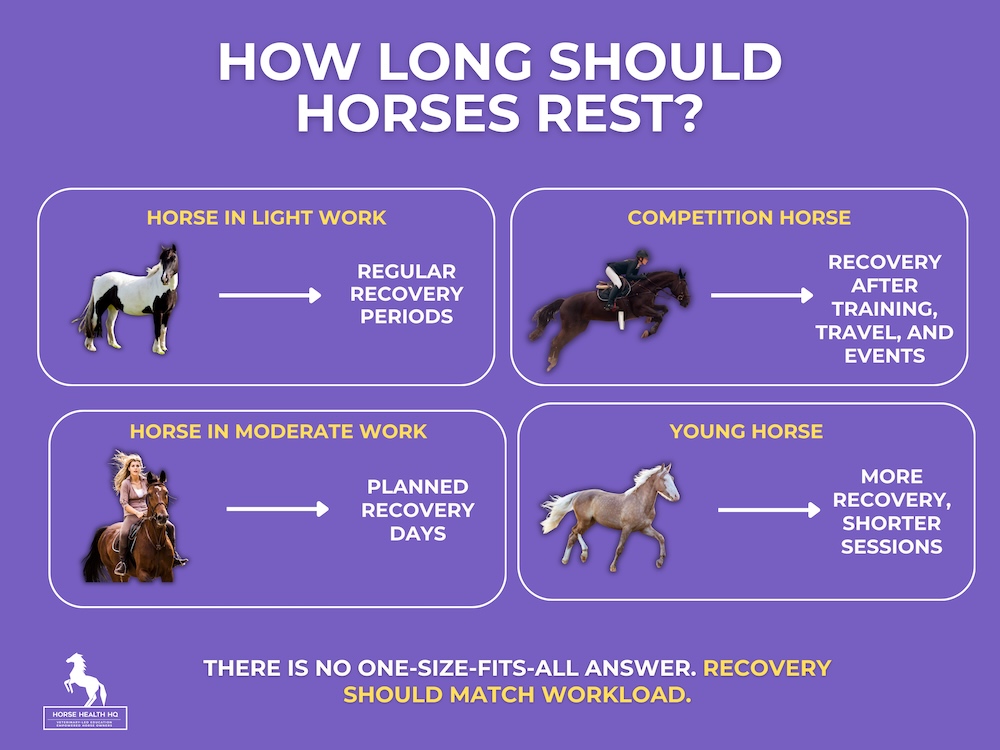
How long should a horse rest? Most horses benefit from regular recovery periods built into their training schedule. For horses in light to moderate work, one or more recovery days each week is often appropriate.
Horses involved in intensive training, competition, travel, rehabilitation, or physically demanding exercise may require additional recovery time.
The ideal amount of rest depends on your horse’s age, fitness level, workload, health status, management, and environment.
Importantly, recovery is not simply time away from riding. It is the period when muscles, tendons, bones, the digestive system, and the nervous system adapt to exercise and training.
If you’re wondering how long horses should rest, the answer is not the same for every horse. However, one principle remains true: recovery is where improvement happens.
Many owners ask veterinarians, “How long should a horse rest between rides, training sessions, competitions, or travel?” The answer depends on workload, fitness, age, health status, and how well the horse recovers from exercise.
Why Recovery Matters More Than Most Horse Owners Realise
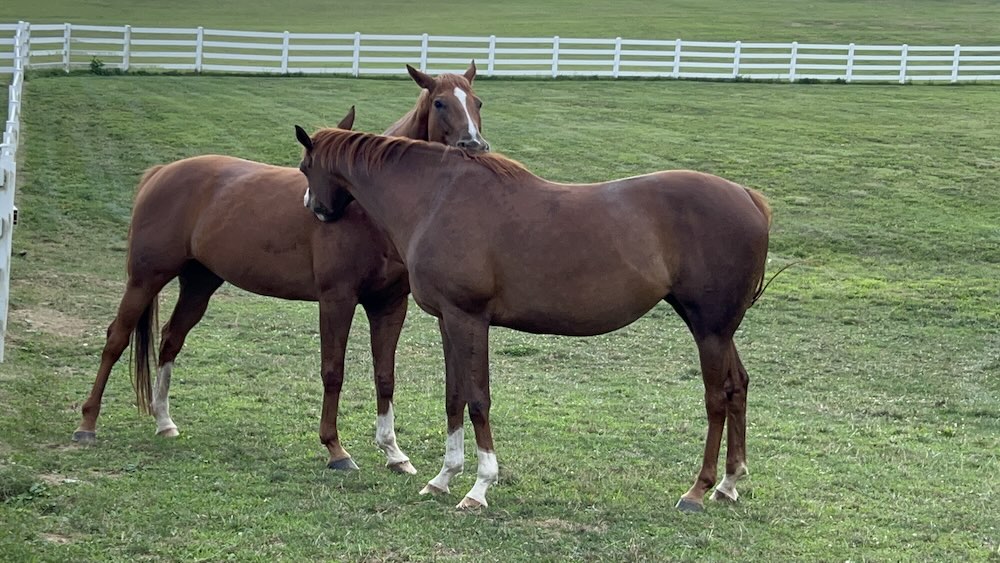
Watch horses living naturally in a paddock and you’ll notice something important. They spend much of their day grazing, walking, interacting socially, resting, and moving at their own pace.
Horses evolved to live in relatively stable social groups with long periods of low-intensity movement. Modern horses often experience very different demands.
Many horses today are expected to cope with:
- Regular ridden work
- Lessons and clinics
- Competition schedules
- Travel and transport
- Changes in riders or handlers
- Stabling
- Limited turnout
- New environments and experiences
Exercise is essential for fitness, health, and athletic performance. However, every training session places physical and mental demands on the horse that require recovery.
One of the biggest misconceptions in horse training is that improvement happens during work. Veterinary exercise physiology tells us something different.
Exercise creates a controlled stress on the body. Recovery allows the body to adapt to that stress.
Without adequate recovery, horses may become physically fatigued, mentally overwhelmed, more prone to injury, and less able to cope with training demands.
What Veterinary Research Tells Us About Recovery
Research in equine exercise physiology has shown that recovery is not a passive process.
During exercise, a horse’s body experiences:
- Increased energy expenditure
- Muscle fatigue
- Mechanical loading of tendons and ligaments
- Increased cardiovascular demand
- Elevated body temperature
- Activation of physiological stress responses
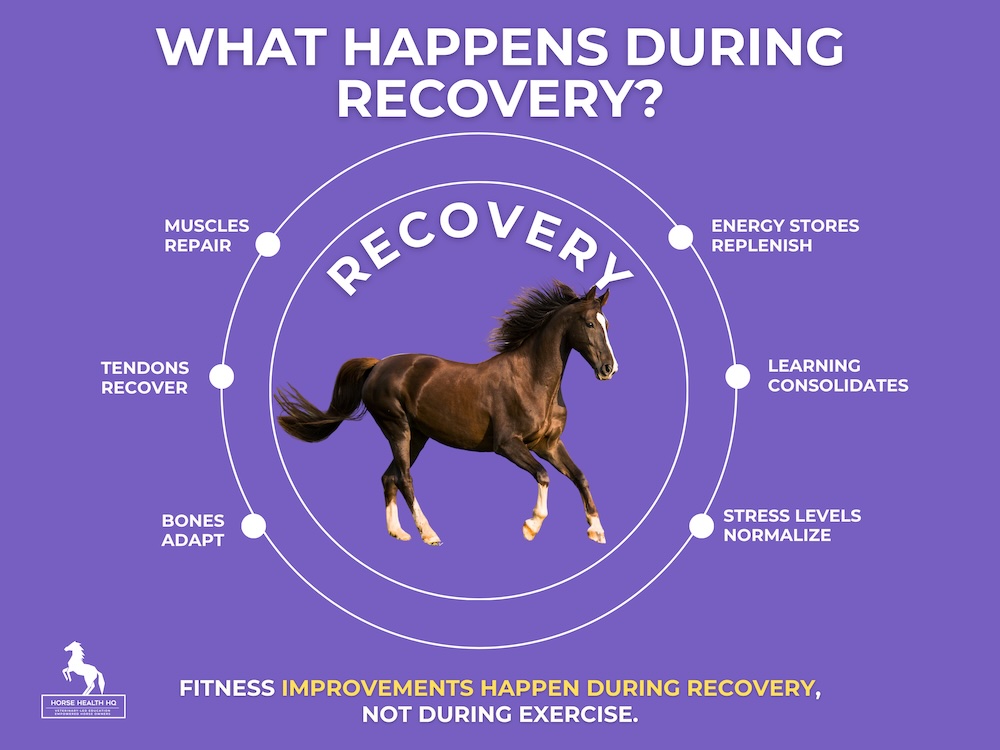
The improvements owners want to see – greater fitness, stronger tissues, improved performance, and increased resilience – occur during recovery periods following exercise.
Recovery allows:
- Muscle repair and adaptation
- Replenishment of energy stores
- Restoration of fluid balance
- Adaptation of bone to exercise
- Recovery of the cardiovascular system
- Normalisation of stress responses
Research in equine sports medicine has shown that bone is constantly balancing damage and repair. Exercise creates microscopic stresses within bone tissue, while recovery allows the body to remodel and strengthen the skeleton. When workload consistently exceeds recovery, damage can accumulate faster than repair, increasing the risk of injury.
This is why recovery should be viewed as part of training rather than time away from training.
A horse that never receives adequate recovery may struggle to adapt to increasing workloads, even if the training programme itself appears appropriate on paper.
Recovery Supports the Heart and Lungs Too
When people think about recovery, they often focus on muscles and joints. However, exercise also places demands on the cardiovascular and respiratory systems.
During conditioning, the heart becomes more efficient at delivering oxygen and nutrients to working muscles, while the respiratory system adapts to support oxygen uptake and carbon dioxide removal. Recovery allows these systems to adapt to training and prepares the horse for future exercise.
One of the simplest indicators of fitness and recovery is how quickly a horse’s heart rate returns toward normal after exercise. Horses that are appropriately conditioned generally recover more quickly than horses that are fatigued, overworked, or poorly conditioned.
This is one reason veterinarians often pay close attention to recovery rates after exercise, rather than focusing solely on how hard a horse worked during a session.
What Happens Inside the Horse’s Body During Rest?
Muscles Repair and Adapt
During exercise, muscle fibres experience microscopic damage. This is a normal and expected part of training.
During recovery, the body repairs these fibres and adapts them to better tolerate future workloads.
Without adequate recovery, muscle fatigue can accumulate, reducing performance and increasing the risk of injury.
Tendons and Ligaments Recover
Tendons and ligaments adapt more slowly than muscles.
Repeated loading without sufficient recovery can contribute to cumulative strain, particularly in horses involved in jumping, eventing, racing, endurance riding, and other demanding athletic disciplines.
Bone Becomes Stronger During Recovery
Bone is living tissue that constantly adapts to the demands placed upon it.
During exercise, especially faster work and higher-impact activities, tiny areas of microscopic damage can develop within the bone. This is a normal part of athletic training and, in healthy horses, actually helps stimulate the body to strengthen and remodel bone over time.
The important point is that repair happens during recovery.
When a horse is given appropriate time to recover, specialised bone cells remove damaged bone and replace it with new, stronger bone tissue. This process helps the skeleton adapt to future workloads and become more resistant to injury.
Problems can arise when the rate of damage exceeds the rate of repair. If intense exercise continues without adequate recovery, microscopic damage can accumulate faster than the body can remodel it. Over time, this may increase the risk of stress-related injuries, particularly in athletic horses.
This is one reason veterinarians place so much emphasis on balancing work with recovery. Fitness is not simply built by training harder. It is built by allowing the body enough time to adapt between training sessions.
Energy Stores Are Replenished
Exercise uses stored energy sources within the body.
Recovery allows replenishment of glycogen stores, restoration of hydration, and correction of electrolyte imbalances that may occur during strenuous work.
The Nervous System Resets
Training is not only physical.
Horses must process new information, learn responses, adapt to rider aids, and cope with environmental challenges.
Periods of recovery appear important for learning, helping horses process and “lock in” new information from training sessions.
Many horse owners notice that a horse struggling with a new exercise one day suddenly understands it after a day or two of lighter work. This is not unusual. Learning often becomes consolidated during recovery periods.
Sleep and Recovery Are Not the Same Thing
Many people think rest simply means sleep.
Veterinarians think about recovery more broadly.
A horse may receive adequate sleep but still fail to recover properly if:
- Workload is excessive
- Travel is frequent
- Turnout is limited
- Stress levels remain elevated
- Pain is present
- Nutritional needs are not being met
Sleep is one component of recovery, but recovery also includes physical, mental, emotional, and physiological restoration.
This distinction is important because many horses appear to be resting while still accumulating physical or psychological stress.
Can Horses Be Overtrained?
Yes.
Although overtraining is commonly discussed in human athletes, horses can also experience physical and mental overload when training demands consistently exceed their ability to recover.
Overtraining is not simply working hard.
It occurs when workload exceeds recovery capacity over time.
This applies not only to muscles and the nervous system, but also to the skeleton itself. Veterinary research has demonstrated that bone requires recovery periods to repair microscopic damage that occurs during exercise. Without sufficient recovery, this damage can accumulate over time.
Risk factors include:
- Consecutive days of intense work
- Frequent competition schedules
- Long-distance transport
- Limited turnout
- Poor recovery planning
- Inadequate nutrition
- Underlying pain or illness
- Chronic stress
Importantly, signs of overtraining often develop before obvious injury occurs.
A horse may appear healthy while showing subtle changes in behaviour, attitude, or performance.
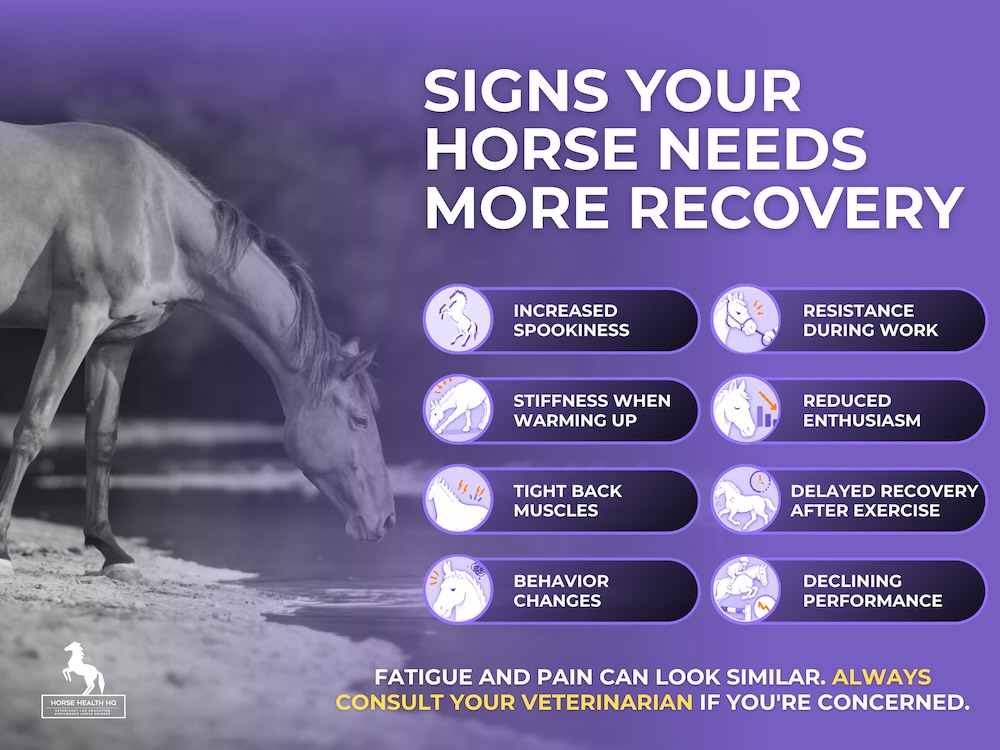
Signs Your Horse May Need More Recovery
Many owners assume behavioural changes reflect a training problem. In some cases, the horse may simply be struggling to cope with its workload.
Physical Signs
- Stiffness during warm-up
- Reduced impulsion
- Shortened stride length
- Delayed recovery after exercise
- Tight back muscles
- Recurrent soreness
- Excessive sweating
- Declining performance
Behavioural Signs
- Increased spookiness
- Resistance during work
- Ear pinning
- Reluctance to be caught
- Difficulty standing quietly
- Head tossing
- Teeth grinding
- Reduced enthusiasm for work
Emotional Signs
- Dull expression
- Reduced curiosity
- Difficulty concentrating
- Withdrawal from surroundings
- Overreaction to minor stimuli
These signs do not automatically mean a horse is fatigued. Pain, gastric ulcers, musculoskeletal problems, dental disease, saddle fit issues, and many other conditions can produce similar symptoms.
Behavioural changes are often one of the earliest clues that a horse is uncomfortable. If you’re unsure whether your horse’s behaviour is related to fatigue, stress, or physical discomfort, read our article on Reading Behaviour: Spotting Pain Before It Becomes a Problem.
Recovery should always be considered as part of the overall assessment.
Recovery Is About Welfare, Not Just Performance
Many owners associate recovery with elite competition horses.
In reality, recovery is a welfare issue for every horse.
Modern equine welfare science recognises that horses need opportunities to:
- Move freely
- Graze
- Interact socially
- Explore their environment
- Experience periods of low stress
Recovery days can contribute to welfare by allowing horses to spend more time engaging in normal horse behaviour.
Good welfare and good performance are not opposing goals.
In many cases, they support one another.
Horses that receive appropriate recovery often demonstrate greater willingness, improved focus, and more consistent behaviour during training.
Recovery is one part of a broader approach to equine welfare. To learn how horse owners and veterinarians can work together to support long-term wellbeing, read Building a Welfare Partnership: How Veterinarians and Owners Work Together.
How Long Should a Horse Rest Between Work Sessions?
This is one of the most common questions horse owners ask.
The honest answer is that there is no single number that suits every horse.
The ideal schedule depends on:
- Age
- Discipline
- Fitness level
- Training intensity
- Travel demands
- Turnout availability
- Health status
- Previous injuries
Horses in Light Work
Many horses in light work cope well with several riding sessions each week combined with turnout and regular recovery periods.
Examples of light work may include:
- Occasional hacking
- Pleasure riding
- Light schooling
- Groundwork sessions
Horses in Moderate Work
Dressage, jumping, eventing, endurance, western performance, and other athletic disciplines often benefit from planned recovery days throughout the week.
Examples of moderate work may include:
- Regular dressage schooling
- Jumping lessons
- Conditioning rides
- Endurance preparation
Horses in Intensive Work
Competition horses frequently require carefully structured recovery periods following hard training sessions, travel, and events.
Recovery should be viewed as part of the training programme rather than a break from it.
The goal is not to maximise work days.
The goal is to maximise adaptation while protecting long-term soundness and wellbeing.
Examples of intensive work may include:
- Frequent competitions
- Race training
- Advanced eventing
- Horses travelling regularly for events
Do Travel Days Count as Work Days?
In many cases, yes.
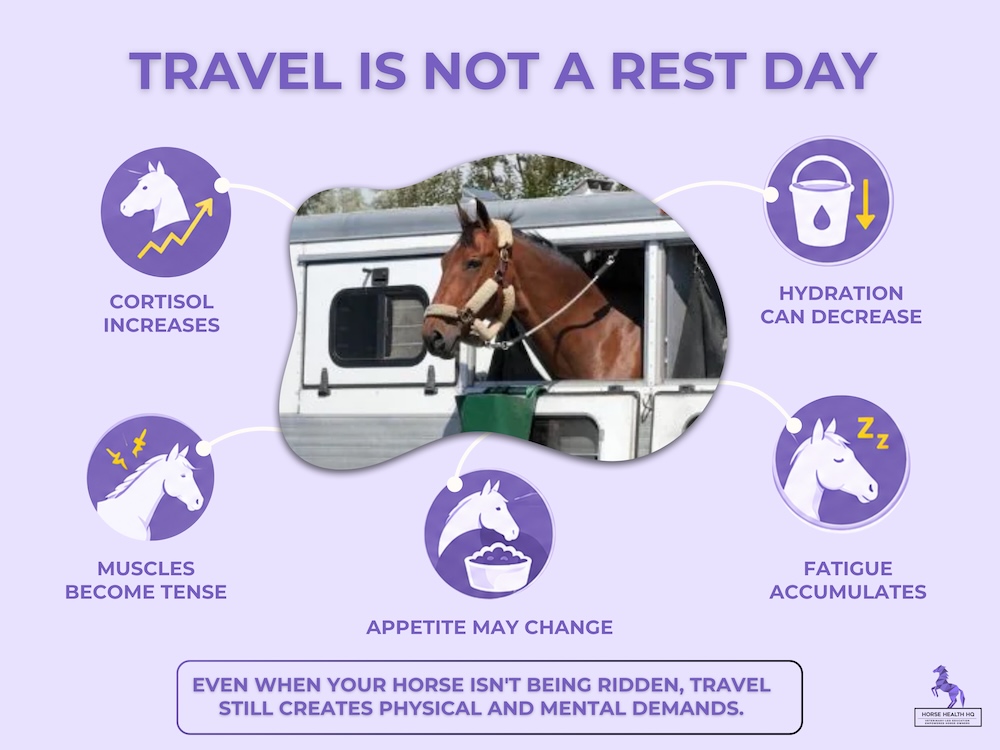
Transport places significant demands on horses, even when they are not being ridden.
Travel can contribute to:
- Fatigue
- Dehydration
- Muscle tension
- Elevated stress levels
- Reduced feed intake
- Gastrointestinal disturbances
Travel affects more than physical recovery. Changes in routine, transport stress, and altered feeding patterns can also influence digestive health. Learn more in The Hidden Impact of Stress on Digestive Health: Routines, Travel, and Barn Life.
A horse that has travelled several hours may require recovery time even if no formal exercise occurred.
For competition horses, transport should be considered part of the overall workload.
Veterinary Perspective
Many owners think of travel as “a day off” because the horse is not being ridden.
In reality, transport can be one of the most physically and mentally demanding experiences a horse encounters. Travel often causes dehydration, elevated stress hormones, muscle fatigue, disrupted eating patterns, and changes in normal behaviour.
For some horses, a long travel day may place greater stress on the body than a routine training session. This is one reason veterinarians often recommend factoring travel into a horse’s recovery schedule rather than viewing it as a day off. Recovery planning should take travel into account just as carefully as exercise.
What Should Horses Do on Rest Days?
A rest day does not necessarily mean complete inactivity.
In fact, movement is beneficial for:
- Joint health
- Blood circulation
- Digestive function
- Muscle recovery
- Mental wellbeing
Ideal recovery-day activities include:
- Turnout
- Grazing
- Social interaction
- Gentle movement around the paddock
- Relaxed exploration of the environment
For most horses, turnout-based recovery is preferable to prolonged confinement.
A horse standing in a stable all day is not necessarily recovering better than a horse moving freely with companions.
Young Horses Need More Recovery
Young horses are still developing physically and mentally, and many do not reach full skeletal maturity until around five to six years of age.
Their:
- Bones are still maturing
- Tendons and ligaments are adapting
- Muscles are developing
- Attention spans are shorter
- Coping mechanisms are less established
For young horses, short training sessions combined with generous recovery periods are often more effective than frequent intensive work.
More work does not necessarily produce faster progress.
Veterinary research has also shown that developing bones need appropriate exercise to become stronger. While excessive workloads can increase injury risk, completely avoiding athletic exercise is not ideal either.
Young horses benefit from regular turnout, free movement, and carefully planned training that gradually exposes their bones, muscles, and tendons to increasing levels of stress. Appropriate loading helps stimulate healthy bone remodelling and skeletal development.
This is one reason many veterinarians encourage turnout and free exercise rather than prolonged confinement. Extended periods in a stable may limit the natural movement that helps support healthy musculoskeletal development.
Horses were designed to move, and regular movement plays an important role in healthy growth and development. In many cases, thoughtful recovery produces better long-term outcomes.
How Do You Know If Your Horse Is Properly Rested?
A well-recovered horse often shows:
- Bright, relaxed eyes
- Normal appetite
- Consistent manure production
- Relaxed breathing
- A loose, swinging walk
- Stable behaviour
- Good focus during work
- Appropriate energy levels
A horse that remains tense, irritable, withdrawn, or unusually reactive may require closer evaluation.
Horses often show subtle signs before more obvious health problems develop. Our guide to Understanding Your Horse’s Subtle Health Signals can help you recognise early changes that may warrant closer attention.
Veterinary Insight
One of the most common mistakes veterinarians see is owners focusing entirely on exercise while overlooking recovery.
Fitness develops when work and recovery are balanced.
If your horse’s behaviour, comfort, or performance changes, it is important to consider workload, management, health, nutrition, and recovery together rather than focusing on any one factor in isolation.
What Should You Do This Week?
Take five minutes and review your horse’s current schedule.
Ask yourself:
- How many days has my horse worked in the last two weeks?
- How many of those sessions were physically demanding?
- Has my horse travelled recently?
- Have I noticed any changes in behaviour, attitude, or performance?
- Does my horse have enough turnout and free movement?
You may discover your horse already has an appropriate balance of work and recovery. Alternatively, you may identify opportunities to adjust their routine and support both performance and wellbeing.
Recovery is not about doing less.
It’s about giving your horse the opportunity to benefit from the work they are already doing.
When Should You Call Your Veterinarian?
Contact your veterinarian if your horse develops:
- Persistent stiffness
- Sudden behavioural changes
- Unexplained loss of performance
- Weight loss
- Recurrent soreness
- Changes in gait
- Reluctance to work
- Signs of pain
Fatigue and medical conditions can appear very similar.
A veterinary examination can help determine whether your horse needs more recovery, further investigation, or treatment.
Frequently Asked Questions
How Long Should a Horse Rest After Exercise?
The amount of recovery needed depends on the intensity and duration of exercise. Light work may require only routine recovery, while strenuous exercise, competition, travel, or hot weather may increase recovery requirements.
How Many Days Off Should a Horse Have?
There is no single rule that applies to every horse. Many horses benefit from regular recovery days, while horses in intensive work may require additional recovery periods.
Is It Bad to Ride a Horse Every Day?
Not necessarily. Some horses tolerate frequent work well if intensity is managed appropriately and recovery needs are met. Problems occur when workload consistently exceeds the horse’s ability to recover.
Do Horses Need Rest Days?
Yes. Recovery periods are important for physical adaptation, mental wellbeing, and long-term soundness.
How Do You Know If a Horse Is Tired?
Common signs include stiffness, declining performance, slower recovery after exercise, increased spookiness, irritability, reduced enthusiasm for work, and behavioural changes.
How Quickly Do Horses Lose Fitness?
Fitness declines gradually. Most horses will not lose meaningful fitness from a single recovery day, which is why planned recovery is an important part of effective conditioning programmes.
Do Travel Days Count as Exercise?
While transport is not exercise, it places significant physical and mental demands on horses and should be considered part of the horse’s overall workload.
How Quickly Do Horses Lose Fitness During Rest?
Most horses do not lose significant fitness from a single recovery day. In fact, planned recovery is an important part of conditioning programmes. Fitness generally declines gradually over time when exercise is reduced, which is why appropriate recovery supports performance rather than hindering it.
Your Takeaways
Recovery is not time lost.
It is where training adaptations occur.
Whether your horse is a pleasure horse, competition partner, young horse, or retired companion, appropriate recovery supports physical health, mental wellbeing, learning, performance, and long-term soundness.
A horse that receives adequate recovery is often more comfortable, more willing, easier to train, and better equipped to cope with the demands of modern horse ownership.
By treating recovery as seriously as training itself, horse owners can support both performance and welfare for years to come.
References and Further Reading
The information in this article is based on current veterinary and equine welfare research, including resources from:
- Whitton RC. Subchondral Bone Injury in Racehorses: An Updated Review.
https://www.ukvetequine.com/content/review/subchondral-bone-injury-in-racehorses - International Society for Equitation Science (ISES) – Equine Welfare Resources.
https://equitationscience.com - Kentucky Equine Research – Exercise Physiology and Conditioning Resources.
https://ker.com - American Association of Equine Practitioners (AAEP) – Horse Owner Education Resources.
https://aaep.org/horsehealth - Mississippi State University Extension. Breaking Horses, Not Bones: Properly Raising Young Horses to Avoid Costly Injuries.
https://extension.msstate.edu/publications/breaking-horses-not-bones-properly-raising-young-horses-avoid-costly-injuries - Oklahoma State University Extension. Physical Conditioning of Horses.
https://extension.okstate.edu/fact-sheets/physical-conditioning-of-horses
Veterinary Review
This article has been reviewed by Dr. Apryle Horbal VMD, MPhil, MRCVS, DAVDC-EQ and incorporates current understanding of equine exercise physiology, recovery, welfare, conditioning, and workload management. Veterinary recommendations should always be tailored to the individual horse.
Disclaimer
This article is intended for educational purposes only and should not replace veterinary advice for your individual horse. If you have concerns about your horse’s health, behaviour, performance, or recovery, contact your veterinarian promptly.