

One of the most common challenges owners face today is how to balance a horse’s need for near-constant forage with the reality that many modern horses simply cannot handle unlimited grass or hay.
If you’ve ever searched online for advice about slow feeders, hay nets or grazing muzzles, you’ve probably come away more confused than when you started.
Some people say hay nets damage teeth. Others claim grazing muzzles are cruel. Some believe horses should have unlimited hay at all times, while others insist restricted feeding is the only way to prevent obesity and laminitis.
The truth is that none of these tools are inherently good or bad. Like most aspects of horse care, success depends on how they’re used.
Used correctly, they can help your horse eat more naturally, maintain a healthy weight, reduce the risk of ulcers and laminitis, and enjoy a calmer, healthier life.
Ponies and easy keepers can gain dangerous amounts of weight. Metabolic horses can founder even on small amounts of lush pasture. And many enthusiastic eaters can finish a full hay net in an hour, then spend the next ten hours hungry, stressed, and uncomfortable.
Slow feeders, hay nets, and grazing muzzles can be life-changing tools. But they must be used thoughtfully.
Used incorrectly, they create frustration, anxiety, or even injury.
Used wisely, they protect your horse’s digestive health, emotional wellbeing, and long-term soundness.
This article will help you understand how to use these tools confidently and compassionately, so you can support your horse’s welfare while avoiding metabolic risk.
Are Slow Feeders Good for Horses?
The short answer is yes, when they’re used correctly.
Slow feeders for horses are designed to slow the rate at which hay is eaten, helping to mimic the natural grazing behaviour horses evolved for. Rather than consuming a large meal in an hour or two and then standing for long periods without forage, slow feeders encourage horses to take smaller bites over a much longer period.
For many horses, this is far closer to the way nature intended them to eat.
However, slow feeders are not a one-size-fits-all solution. A horse that becomes frustrated, cannot access enough forage, or is introduced to a feeder with holes that are too small may experience unnecessary stress rather than the intended benefits.
The goal is never to make eating difficult. The goal is simply to make forage last longer while allowing your horse to eat calmly and comfortably throughout the day.
When used appropriately, slow feeders can help:
- Extend the time your horse spends eating
- Reduce long periods without forage
- Support digestive health
- Assist with weight management
- Reduce hay wastage
- Keep stable-kept horses occupied for longer
The best slow feeder for horses is the one that suits your horse’s age, temperament, dental health and management system. Some horses adapt immediately, while others need a gradual introduction before they become confident using one.
Why Horses Need a Steady Flow of Fibre
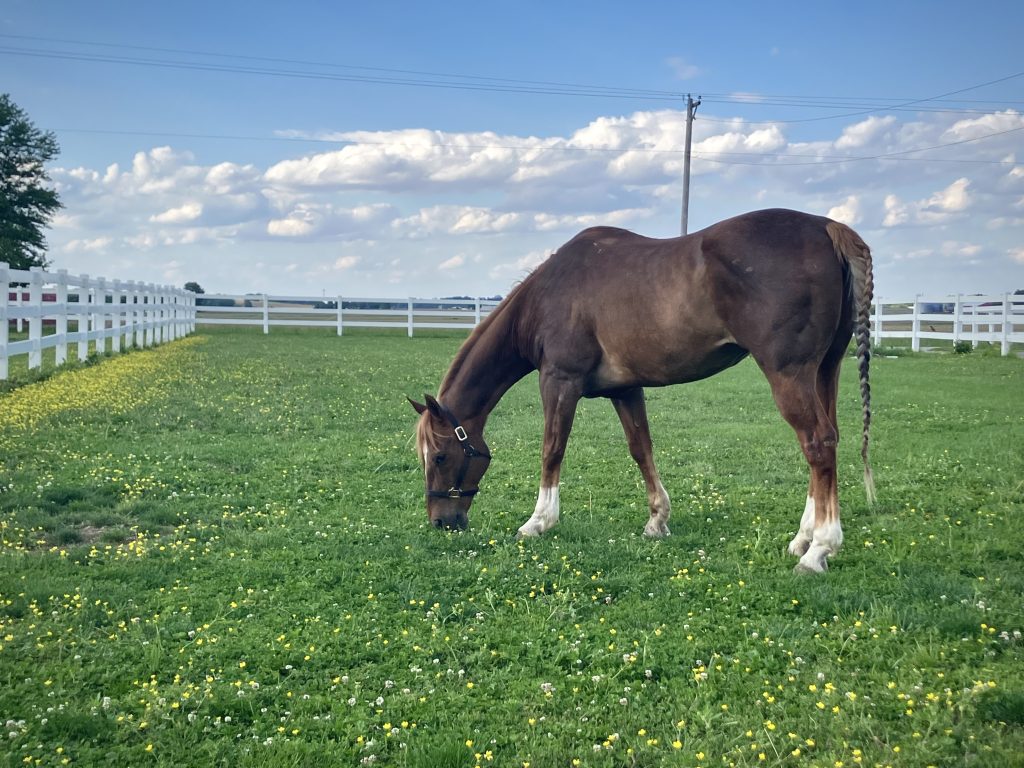
Horses evolved to roam and graze for up to 16 to 18 hours each day, taking thousands of small bites as they move across the landscape. Their digestive system is designed around this almost continuous intake of fibre.
Unlike people, horses produce stomach acid continuously, whether they are eating or not. When a horse is grazing or eating hay regularly, the fibrous feed helps form a protective mat in the stomach, reducing the chance of acid splashing onto the more sensitive upper (non-glandular) portion of the stomach.
Long periods without forage can increase the risk of irritation and gastric ulcers.
If you’d like to better understand what causes gastric ulcers, the latest research and the practical steps owners can take to reduce the risk, read our article on the real risk factors for gastric ulcers.
Further along the digestive tract, billions of beneficial microbes in the hindgut rely on a steady supply of fibre to ferment forage and produce energy. When forage intake is interrupted for long periods, this delicate microbial balance can be disturbed, potentially affecting digestion, manure quality and overall gut health.
To learn more about why fibre is so important and how hindgut fermentation supports your horse’s digestive health, read our guide to hindgut fermentation in horses.
This is why providing forage throughout much of the day is one of the most important foundations of good horse management.
A horse without forage experiences:
- Hunger and frustration
- Rising stomach acidity
- Increased ulcer risk
- Disrupted hindgut fermentation
- Behaviour changes linked to stress
- Chewing on wood, fencing, rugs or stables
- Increased cortisol levels
Forage needs to be available for most of the day. But unrestricted access isn’t always safe or realistic. This is where slow-feeding strategies become essential.
Slow Feeders: Supporting Gut Health and Mental Health
Slow feeders extend eating time by reducing the rate at which horses consume hay. They encourage small, frequent bites that better match the horse’s natural feeding pattern.
Benefits of Slow Feeders
- Reduce the risk of ulcers
- Support healthy hindgut fermentation
- Prevent long fasting periods
- Minimise boredom and stable vices
- Improve weight management
- Reduce hay wastage
- Encourage steady insulin levels
- Help anxious horses relax through consistent eating
Case story:
A gelding was treated for recurring mild colics lived in a stable overnight and consumed his entire hay allocation by 8 pm. By morning, he had an empty stomach, high acidity, and restless behaviour. Introducing two slow feeders spaced around the stable extended his feeding time from 2 hours to nearly 10.
Within a few weeks, the owner noticed he was leaving hay in the morning for the first time, appeared far more settled overnight and stopped pacing his stable before breakfast. His episodes of mild colic also disappeared.
Are Hay Nets Bad for Horses?
One of the most common questions horse owners ask is whether hay nets are actually bad for horses.
The answer depends far more on how the hay net is used than on the hay net itself.
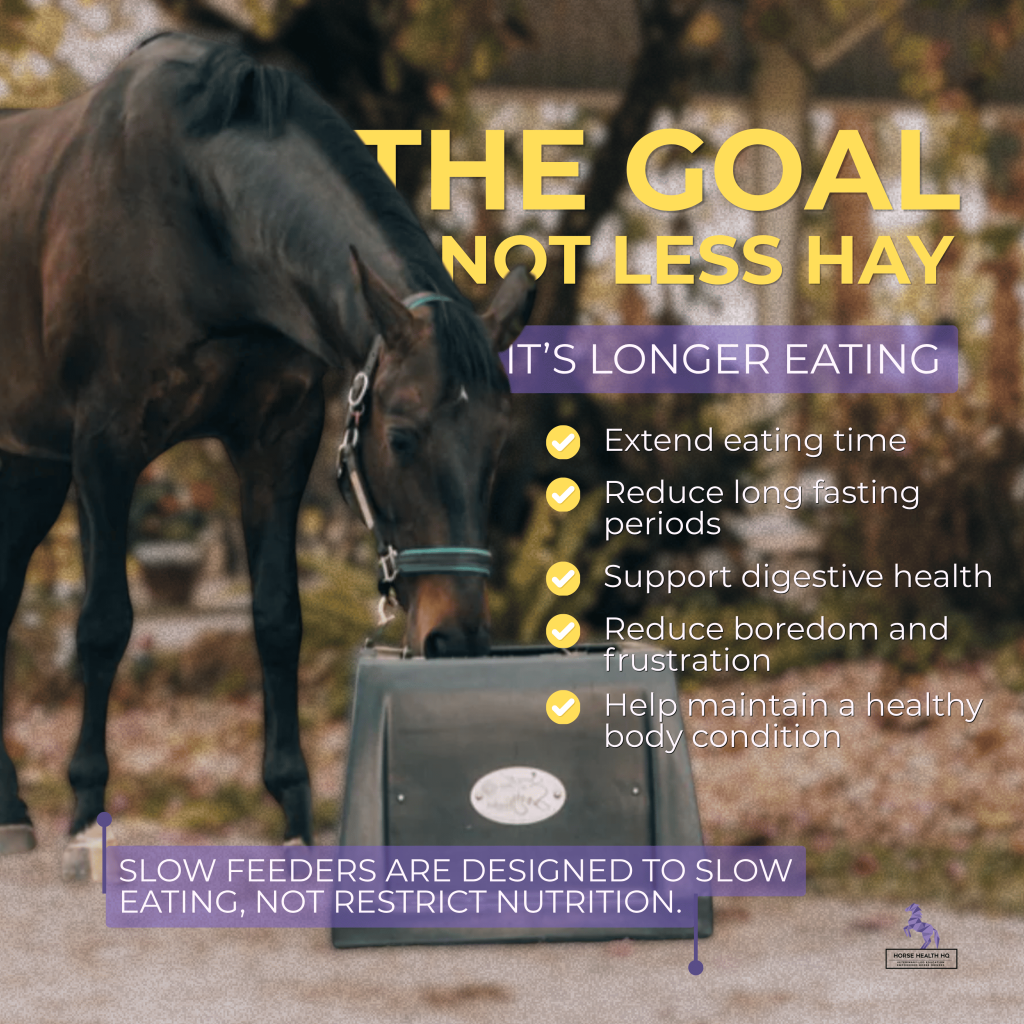
When used correctly, hay nets can be an excellent way to slow forage intake, reduce hay wastage and help horses spend more time eating throughout the day. For horses that tend to consume an entire hay ration in a short period, a well-designed hay net can support digestive health by reducing long periods without forage.
However, hay nets can cause problems if they are used incorrectly.
Potential issues include:
- Hanging the net too high, forcing the horse to eat in an unnatural position.
- Using holes that are too small, leading to frustration or excessive pulling.
- Leaving damaged nets in use, increasing the risk of injury.
- Providing too little hay, resulting in long fasting periods despite using a slow feeder.
Whenever possible, horses should be able to eat with their head and neck in a more natural position. If you use a hay net, hang it low enough to encourage a comfortable posture while ensuring it cannot become tangled around your horse’s legs or shoes.
For many horses, especially those that are overweight or prone to laminitis, a hay net can be an extremely useful management tool. The key is choosing the right net, introducing it gradually and making sure your horse still receives enough forage each day.
A hay net should never be used simply to make your horse work harder for less food. Its purpose is to slow eating, not restrict nutrition.
Unlimited Hay vs Slow Feeders: Which Is Better?
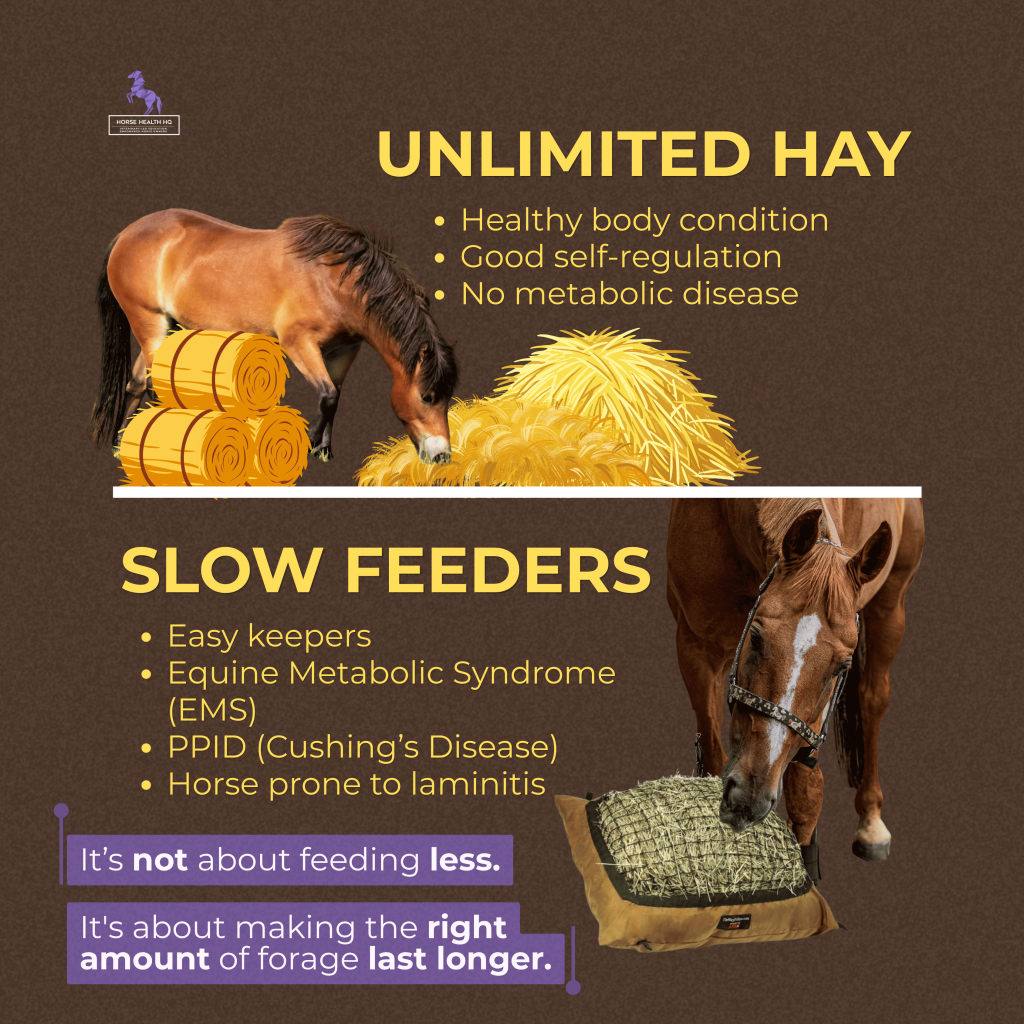
Many horse owners have heard that horses should have access to forage at all times. While that’s true for many horses, it’s not always as simple as providing unlimited hay.
For horses that maintain a healthy body condition, have no history of metabolic disease and regulate their own intake well, free access to good-quality forage is often the most natural and welfare-friendly option. It allows them to eat little and often, supporting digestive health, reducing boredom and encouraging normal behaviour.
However, not every horse can safely manage unlimited hay.
Some horses and ponies are naturally “easy keepers” and will continue eating long after their nutritional needs have been met. Others have underlying conditions that make unrestricted access to forage a genuine health risk.
Unlimited hay may not be appropriate for horses that are:
- Overweight or obese
- Diagnosed with Equine Metabolic Syndrome (EMS)
- Insulin resistant
- Living with PPID (Cushing’s disease)
- Recovering from, or at risk of, laminitis
For these horses, the goal isn’t to stop them eating. The goal is to slow their intake while still allowing them to spend as much of the day as possible chewing and foraging.
This is where slow feeders can make an enormous difference.
A well-designed slow feeder allows many horses to receive the same daily hay allocation over a much longer period. Instead of finishing their hay in just a few hours and standing without forage for the rest of the day, they can continue eating steadily, helping to support gut health, reduce boredom and minimise frustration.
Remember, a slow feeder is not designed to feed less hay. It’s designed to make the right amount of hay last longer. Remember, every horse is designed to eat 1.5-2% of their body weight in dry matter weight hay and/or grass every day.
This means that a horse weighing 1000 pounds should be eating 15-20 pounds of hay and/or grass in a 24-hour period! We use the dry matter weight because the water in grass makes it much heavier than dry hay – and that dry weight is what we actually measure to calculate appropriate forage intake.
Every horse is different. The best feeding system is one that maintains a healthy body condition, supports digestive health and fits your horse’s individual medical needs. If you’re unsure how much forage your horse should receive, speak with your veterinarian or an equine nutritionist before making significant changes to their diet.
| Feeding Option | Best For | Advantages | Things to Consider |
|---|---|---|---|
| Unlimited hay | Healthy horses at ideal weight | Most natural feeding pattern | Not suitable for every horse |
| Slow feeder hay net | Horses that eat too quickly | Extends eating time | Needs correct hole size |
| Rigid slow feeder | Stable-kept horses | Natural head position | Must be safely designed |
| Grazing muzzle | Horses on lush pasture | Reduces grass intake | Must fit correctly |
| Dry lot | Severe metabolic disease | Excellent grass control | Requires careful forage management |
Choosing the Best Slow Feeder for Your Horse
Not all slow feeders suit all horses. Choosing the correct system is essential for both welfare and practicality.
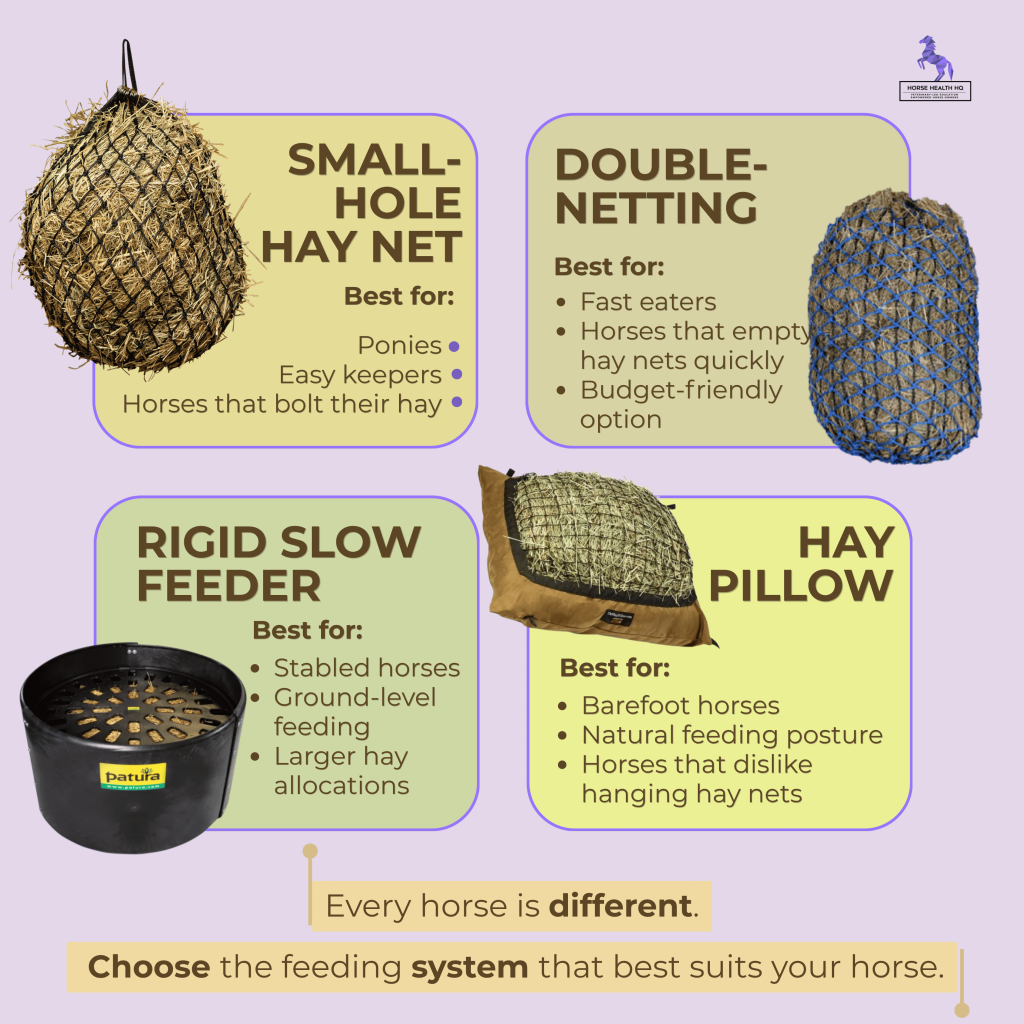
1. Small-Hole Hay Nets
Small-hole hay nets are one of the most popular slow feeders for horses because they are inexpensive, widely available and effective at extending eating time.
Best for:
- Easy keepers
- Ponies
- Horses that bolt their hay
Advantages:
- Increases eating time
- Reduces hay wastage
- Easy to hang in stables or paddocks
- Available in different hole sizes
Things to consider:
- Very small holes can frustrate inexperienced horses.
- Hanging the net too high encourages an unnatural eating posture.
- For shod horses, ensure the net is positioned safely to minimise the risk of entanglement.
2. Double-Netting
Double-netting involves placing one hay net inside another, making it more difficult for horses to pull out large mouthfuls of hay. It’s a simple, inexpensive way to slow intake without purchasing a specialised slow feeder.
Best for:
- Horses that empty standard hay nets too quickly
- Greedy eaters
- Owners looking for a low-cost slow-feeding option
Advantages:
- Significantly slows hay consumption
- Inexpensive to set up
- Reduces hay wastage
- Can be used with existing hay nets
Things to consider:
- Some horses become frustrated if introduced too quickly.
- Monitor your horse carefully during the first few days to ensure they are eating comfortably.
- If your horse struggles to pull hay through the nets, a purpose-built slow feeder may be a better option.
3. Rigid Slow Feeders (metal or plastic grids)
Rigid slow feeders use a solid frame with a mesh or grid to slow forage intake while allowing horses to eat from a lower, more natural position. They are available in a wide range of sizes for both stables and paddocks.
Best for:
- Stable-kept horses
- Horses that benefit from eating at ground level
- Horses wearing shoes (depending on the design)
Advantages:
- Encourages a more natural head and neck position
- Reduces hay wastage
- Often safer than hanging hay nets when correctly designed
- Holds larger amounts of hay for longer feeding periods
Things to consider:
- Choose feeders with smooth edges and strong construction.
- Ensure the design is appropriate for shod horses to minimise the risk of feet becoming trapped.
- Position the feeder on well-drained ground to reduce hay contamination in muddy conditions.
4. Hay Pillows
Hay pillows are soft, floor-based slow feeders that allow horses to eat from ground level while extending feeding time. Many horses adapt to them quickly because they closely mimic natural grazing posture.
Best for:
- Barefoot horses
- Horses that dislike hanging hay nets
- Stable or yard (paddock) feeding
Advantages:
- Encourages a natural eating posture
- Extends eating time
- Reduces hay wastage
- Simple to fill and move around
Things to consider:
- Generally not recommended for shod horses because shoes may catch in the fabric or mesh.
- Remove spoiled hay promptly, particularly in wet or muddy conditions.
- Regularly inspect the material for signs of wear or damage and replace it if necessary.
Which Horses Benefit Most From Slow Feeders?
While almost any horse can benefit from eating forage more slowly, slow feeders are particularly useful for horses that need extra support with weight management, digestive health or long periods of confinement.
Here are some of the horses that often benefit most from slow feeders.
Easy Keepers and Ponies
Easy keepers and many pony breeds are naturally efficient at extracting energy from their feed. Unfortunately, this also means they are more likely to become overweight if they consume hay or pasture too quickly. Slow feeders help extend eating time without necessarily reducing the total amount of forage available, making them an excellent tool for healthy weight management.
Horses Prone to Laminitis or Metabolic Disease
Horses diagnosed with Equine Metabolic Syndrome (EMS), insulin resistance or PPID (Cushing’s disease), as well as those with a history of laminitis, often require careful control of their calorie intake. A slow feeder can help these horses consume their allocated forage over a longer period, reducing long fasting periods while supporting safer feeding practices.
Stable-Kept Horses
Horses that spend part or all of the day in a stable can quickly become bored if they finish their hay within a few hours. Slow feeders encourage longer eating times, helping to reduce boredom, frustration and stable vices such as weaving, crib biting and wood chewing.
Horses on Box/Stall Rest
Box or stall rest can be mentally challenging for many horses. Without the ability to graze or move freely, they often spend long periods with little to do. Slow feeders help keep the digestive system active while providing mental stimulation and reducing stress during recovery.
Horses That Bolt Their Hay
Some horses consume an entire hay ration remarkably quickly. These “greedy eaters” may then spend many hours without forage, increasing the risk of digestive upset and unwanted behaviours. Slow feeders naturally encourage smaller bites and a steadier eating pattern.
Horses Prone to Gastric Ulcers
Because horses continuously produce stomach acid, long periods without forage can increase the risk of gastric ulcers. By extending the time forage is available, slow feeders help many horses maintain a more consistent supply of fibre throughout the day.
Senior Horses
Older horses can also benefit from slow feeders, although the feeder must be appropriate for their needs. Horses with worn teeth or dental disease may struggle with very small hay net openings, so larger holes or alternative slow-feeding systems are often more suitable.
Performance Horses
Performance horses often spend time travelling, competing or stabled between training sessions. Slow feeders help provide a more natural pattern of forage intake during these periods, supporting digestive health and encouraging calmer behaviour while away from home.
No single feeding system suits every horse. The best slow feeder for horses is one that matches your horse’s age, health, eating habits and daily management routine while allowing them to eat comfortably and consistently throughout the day.
How to Introduce a Slow Feeder Without Stress
1. Start with larger hole sizes.
If your horse has never used a slow feeder before, begin with a feeder that has larger openings. This allows them to learn how it works without becoming frustrated.
2. Offer loose hay alongside the slow feeder.
Place the slow feeder beside a small amount of loose hay so your horse doesn’t feel anxious about where their next mouthful is coming from. This encourages curiosity rather than frustration.
3. Make the first mouthful easy.
Pull several small tufts of hay through the openings before offering the feeder. Giving your horse an immediate reward helps them quickly understand how the slow feeder works and builds confidence from the very first bite.
4. Keep the first sessions short.
Allow your horse to use the slow feeder for 15 to 30 minutes at first before returning to their normal feeding routine. Gradually increase the time over several days as they become more comfortable.
5. Gradually reduce the loose hay.
As your horse learns to eat confidently from the slow feeder, reduce the amount of loose hay until the feeder becomes their primary source of forage.
6. Watch your horse, not the clock.
Every horse learns at a different pace. Watch for signs of calm eating and relaxed behaviour rather than rushing to the next step.
7. Only reduce the hole size if necessary.
If your horse is still finishing their hay too quickly after they have adapted, you can consider moving to a smaller hole size. There’s no advantage in making eating more difficult than it needs to be.
If your horse paws repeatedly, bites aggressively at the feeder, gives up eating, or appears unusually anxious, the system needs adjusting. Larger holes, a different feeder design or a slower introduction may be all that’s required.
Remember: the goal isn’t to make your horse work harder for food. It’s to help them eat more naturally over a longer period. A horse that calmly spends eight hours eating is far better off than one that finishes its hay in an hour and spends the rest of the day hungry and frustrated.
Common Mistakes With Slow Feeders
Even the best slow feeder won’t improve your horse’s welfare if it’s used incorrectly. Fortunately, most problems are easy to avoid with a few simple adjustments.
1. Choosing Holes That Are Too Small Too Soon
This is one of the most common mistakes owners make. If the openings are too small for a horse that has never used a slow feeder, frustration can quickly replace curiosity.
Start with larger holes and only move to a smaller size if your horse is still eating too quickly after they have adapted.
2. Restricting Hay Instead of Slowing It Down
A slow feeder should make your horse’s hay last longer, not reduce the total amount of forage they receive. Horses still need enough fibre each day to support healthy digestion and normal behaviour.
3. Hanging Hay Nets Too High
Hay nets suspended high off the ground force horses to eat with an unnatural head and neck position.
Whenever it is safe to do so, position hay so your horse can eat in a lower, more natural posture while ensuring the feeder cannot become tangled around their legs or shoes.
4. Ignoring the Risks for Shod Horses
Ground-level hay nets and hay pillows are not suitable for every horse.
Horses wearing front shoes can occasionally catch a shoe in traditional netting, creating a risk of panic and injury. If your horse is shod, consider using a rigid slow feeder with solid sides or a slow-feeding system specifically designed to minimise this risk.
5. Using Damaged or Worn Feeders
Regularly inspect hay nets, straps and attachment points for wear. Small holes or broken cords can quickly become safety hazards if a horse becomes entangled.
6. Only Providing One Feeder for Multiple Horses
In group paddocks, a single slow feeder often encourages competition and resource guarding.
Providing several feeding stations spaced well apart allows lower-ranking horses to eat more comfortably and reduces conflict within the herd.
7. Forgetting to Weigh the Hay
Many owners estimate how much hay they feed each day, but visual estimates can be surprisingly inaccurate.
If your horse is overweight, prone to laminitis or has Equine Metabolic Syndrome (EMS), weighing hay is one of the simplest ways to ensure they receive an appropriate daily ration.
8. Expecting Every Horse to Like the Same Feeder
Some horses prefer hay nets, while others are far more comfortable using rigid feeders or hay pillows. If one design causes frustration, don’t assume slow feeders aren’t suitable for your horse. Often, a different style makes all the difference.
Grazing Muzzles: A Powerful Welfare Tool, Not a Punishment
Many owners feel guilty about using grazing muzzles. But when introduced correctly, muzzles are one of the kindest and most effective ways to give horses turnout, movement, and social interaction while protecting their metabolism and feet.
Are Grazing Muzzles Cruel?
One of the biggest misconceptions about grazing muzzles is that they are cruel. In reality, a properly fitted grazing muzzle is often one of the kindest tools available for horses that need restricted access to pasture.
The purpose of a grazing muzzle isn’t to stop a horse from eating. It’s to slow the amount of grass they consume while still allowing them to enjoy turnout, movement and companionship. Horses can continue to graze, walk, interact with herd mates and express many of their natural behaviours, just at a slower rate.
For horses that are overweight, have Equine Metabolic Syndrome (EMS), PPID (Cushing’s disease), insulin resistance or a history of laminitis, unrestricted grazing can have serious health consequences.
Recurrent laminitis can cause permanent damage to the sensitive structures within the hoof, leading to chronic pain, reduced mobility and, in severe cases, euthanasia.
When viewed in that context, a well-fitted grazing muzzle is often the more compassionate option.
That said, grazing muzzles must be used correctly. A poorly fitting muzzle can cause rubbing, restrict normal jaw movement or create unnecessary frustration. Horses should always be introduced gradually, monitored closely during the first few days and checked regularly for signs of discomfort or skin irritation.
A grazing muzzle should also never be used as a substitute for good management. Horses still need access to fresh water, appropriate forage, regular health checks and time each day without the muzzle.
Ultimately, the goal is not simply to reduce grass intake. It’s to allow horses to spend as much time as possible outdoors, moving freely and socialising with other horses, while protecting them from the potentially devastating effects of obesity and laminitis.
A well-managed horse wearing a correctly fitted grazing muzzle is almost always better off than a horse confined to a stable or small yard/paddock because grazing has become too risky.
Why Grazing Muzzles Are So Important
- Reduce grass intake by 30–80 percent
- Allow safe turnout on rich pasture
- Prevent dangerous weight gain
- Reduce laminitis risk
- Support mental wellbeing through movement and social time
- Improve gut motility compared with yard/small paddock confinement
The exact reduction depends on the design of the muzzle, pasture conditions, grass length and how experienced your horse becomes at grazing while wearing it.
Case story:
A small cob mare I worked with had repeated bouts of laminitis every spring. She became anxious when isolated on a dry lot. After carefully introducing a grazing muzzle, she joined her paddock group again.
Within a few weeks, the owner noticed she settled back into her paddock routine, became far less anxious around her herd mates and maintained a healthier weight throughout spring without another laminitic episode.
How to Fit a Grazing Muzzle Correctly
A properly fitted muzzle should allow your horse to:
- Chew
- Drink
- Breathe freely
- Move their jaw
- Express normal behaviour
Fit Checklist
- Two fingers space under straps
- Soft padding around the nose
- No pressure points under the chin
- Grazing hole aligned centrally
- Breakaway strap for safety
- Ability to fully open the mouth and yawn
If the muzzle restricts jaw movement, it is too tight.
Introducing a Grazing Muzzle Without Stress
A gradual approach helps the horse understand that the muzzle allows grazing, not prevents it.
Gentle Introduction Steps
- Let the horse sniff and touch the muzzle without pressure.
- Place it on for a minute, then remove and reward.
- Increase time in small increments each day.
- Allow the horse to graze in an easy area first, not short grass.
- Ensure they can drink easily from their usual trough.
Most horses adapt within a few days when introductions are calm and consistent.
Can Horses Eat and Drink Normally Wearing a Grazing Muzzle?
A correctly fitted grazing muzzle should allow your horse to graze, drink and breathe normally.
Although the muzzle reduces the amount of grass your horse can consume with each bite, it should never prevent them from carrying out these essential behaviours. Most horses quickly learn how to graze and drink while wearing a well-fitted muzzle.
Before leaving your horse unattended, always watch them wearing the muzzle for a short period to make sure they can:
- Graze comfortably
- Drink freely from their usual water source
- Breathe normally during exercise and rest
- Chew without restriction
If your horse struggles to drink, appears distressed, or cannot grasp grass effectively, the muzzle may not fit correctly or may not be the right design for your horse.
Regularly check the grazing hole to ensure it isn’t blocked with mud, sand or compacted grass, as this can make grazing more difficult and increase frustration.
A correctly fitted grazing muzzle should reduce grass intake, not prevent your horse from behaving like a horse.
How Long Can a Horse Wear a Muzzle?
Most horses safely wear grazing muzzles for:
- 6 to 12 hours per day in moderate weather
- Less in extreme heat
- Only during pasture turnout
Avoid 24-hour wear. Horses need breaks for:
- Eating hay
- Resting without restriction
- Grooming
- Comfortable chewing movements
Check for rubs daily, especially during the first two weeks.
Behavioural Signs Your Horse Is Coping Well
A horse using slow feeders or muzzles correctly will show:
- Calm, steady grazing or eating
- Normal breathing
- Soft body language
- Clean, consistent manure
- Stable weight
- Routine drinking
They should look relaxed, not desperate.
Warning Signs to Adjust Your System
Watch for:
- Frenzied attempts to graze
- Pawing or striking the ground
- Refusal to drink
- Excessive sweating
- Loss of manure quality
- Isolation from herd mates
- Weight loss or anxiety
These signs indicate the need to:
- Refit the muzzle
- Loosen straps
- Increase forage during breaks
- Re-evaluate pasture access
- Consider alternative slow-feeding tools
Always adapt based on your horse’s behaviour.
Dry Lots, Mixed Systems, and Creative Feeding Solutions
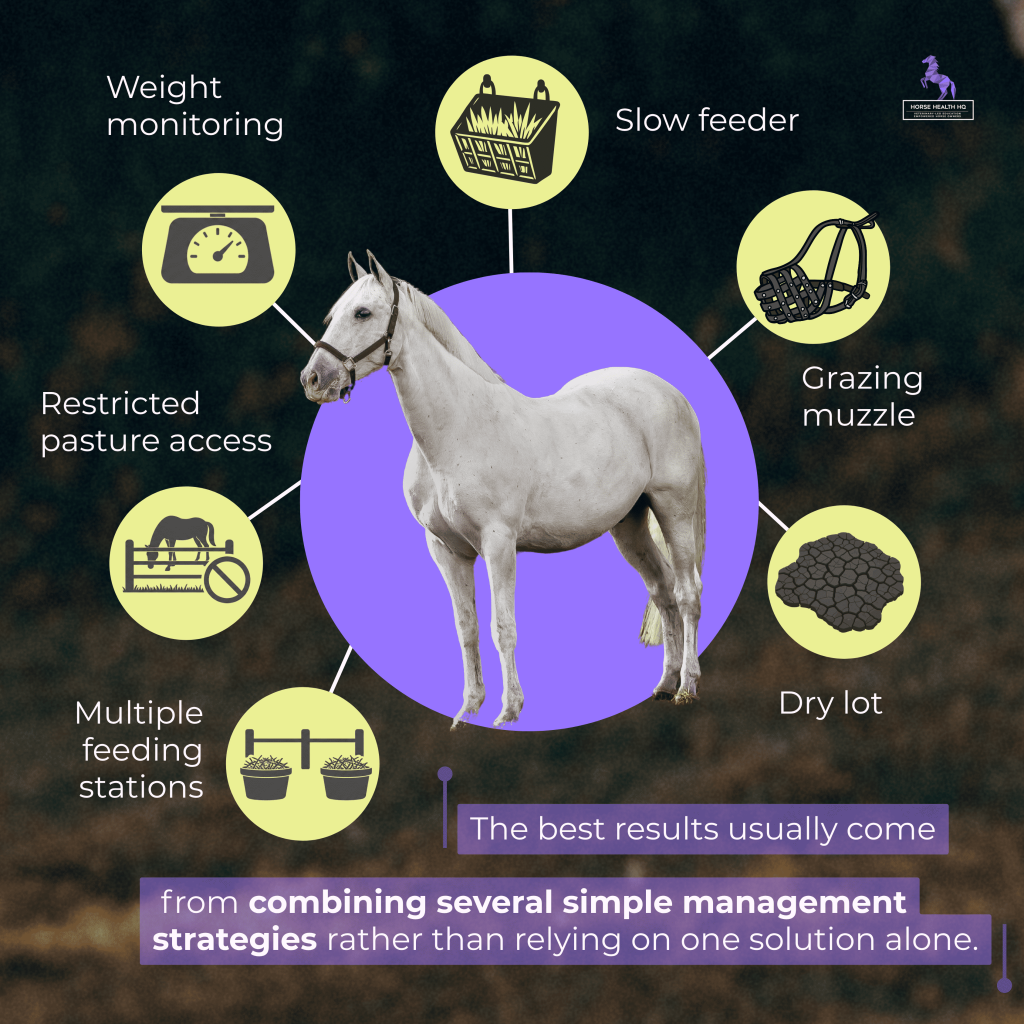
Sometimes using a single tool isn’t enough. Many horses benefit from a blended approach.
Examples of Successful Feeding Strategies
- Muzzle for turnout + slow feeder in the yard/paddock
- Dry lot with unlimited low-sugar hay in nets
- Small paddocks with multiple slow feeders to reduce competition
- Rotational grazing with restricted hours on lush grass
- Night turnout with muzzle + day yard/paddock feeding
These combinations allow you to manage calories without sacrificing welfare.
Horses Who Need Special Consideration
1. Senior Horses
May struggle with very small hay net holes or tough hay.
2. Horses With Dental Issues
Need softer forage and easier access.
3. Horses With Anxiety
Require slower transitions and careful observation.
4. Horses on Box/Stall Rest
Slow feeders become essential to keep the gut moving.
5. Ponies With Metabolic Syndrome
May need a muzzle even on sparse grass.
The Takeaway
Slow feeders, hay nets and grazing muzzles are not restrictive tools when they’re used thoughtfully. They’re welfare tools that help horses eat in a way that’s much closer to how nature intended while protecting them from many of the challenges of modern management.
They help horses:
- Eat slowly
- Stay calm
- Avoid metabolic disease
- Prevent ulcers
- Stay out of the stable and enjoy turnout
Whether your goal is preventing laminitis, supporting digestive health, extending forage availability or simply reducing boredom in the stable, the right feeding system can make a remarkable difference to your horse’s physical and mental wellbeing.
Every horse is different. Observe how your horse eats, how they behave and how they maintain their weight, then choose the management system that best supports their individual needs.
The goal isn’t simply to make forage last longer.
The goal is to keep your horse healthier, happier and able to enjoy the simple act of eating for as much of the day as possible.
Frequently Asked Questions About Slow Feeders, Hay Nets and Grazing Muzzles
Are slow feeders good for horses?
Yes, when used correctly, slow feeders are an excellent way to encourage horses to eat more slowly and mimic their natural grazing behaviour. They can help reduce long periods without forage, support digestive health, minimise boredom and assist with weight management. The key is choosing the right feeder for your horse and ensuring they still receive enough forage each day.
Are hay nets bad for horses?
Hay nets are not inherently bad for horses. In fact, they can be an effective way to slow hay consumption and reduce waste. Problems usually occur when hay nets are hung too high, have holes that are too small, are damaged, or are used to restrict the total amount of forage rather than simply slowing intake.
Can slow feeders help horses lose weight?
Slow feeders don’t directly cause weight loss, but they can play an important role in a weight management plan. By extending the time it takes a horse to eat its allocated forage, slow feeders help reduce boredom and hunger while making it easier to manage calorie intake. Weight loss should always be achieved by balancing appropriate nutrition, exercise and veterinary advice where needed.
Can horses wear a grazing muzzle all day?
Grazing muzzles are generally intended for use during turnout rather than continuously. Most horses can comfortably wear a well-fitted muzzle for several hours each day, provided they can graze, drink and breathe normally. They should be removed daily to allow unrestricted eating, grooming and regular skin checks.
Can horses drink while wearing a grazing muzzle?
Yes. A correctly fitted grazing muzzle should allow a horse to drink freely from its usual water source. If your horse struggles to drink while wearing a muzzle, the fit should be checked immediately before continued use.
Are grazing muzzles cruel?
No. When properly fitted and used appropriately, grazing muzzles are considered a valuable welfare tool rather than a punishment. They allow horses to enjoy turnout, movement and social interaction while reducing the risk of obesity and laminitis. A horse comfortably grazing with a muzzle is often better off than one confined to a stable because pasture is unsafe.
What’s the best slow feeder for horses?
There is no single best slow feeder for every horse. The ideal choice depends on your horse’s age, eating habits, dental health, management system and weight goals. Some horses do well with small-hole hay nets, while others are better suited to rigid slow feeders or hay pillows that encourage a more natural eating position.
Should horses always have access to forage?
Most horses benefit from having forage available for much of the day because their digestive system is designed for continuous grazing. However, horses that are overweight or have conditions such as Equine Metabolic Syndrome (EMS), PPID or a history of laminitis may require carefully managed forage intake. Slow feeders can help these horses eat more slowly while still supporting gut health.
Can slow feeders help prevent gastric ulcers?
Long periods without forage are one of several factors that can increase the risk of gastric ulcers. By extending eating time and reducing fasting periods, slow feeders may help support stomach health as part of an overall ulcer prevention strategy. Horses showing signs of gastric ulcers should always be examined by a veterinarian.
How do I know if my horse is coping well with a slow feeder or grazing muzzle?
A horse that is coping well should appear relaxed, continue eating and drinking normally, maintain a healthy body condition and show little or no frustration. If your horse paws excessively, becomes anxious, refuses to eat or drink, develops rubs or loses weight unexpectedly, it’s time to review the feeding system and seek advice from your veterinarian if needed.
Disclaimer
This article provides general information only and does not replace veterinary advice for your individual horse. If you’re concerned, contact your veterinarian promptly.