

If you’ve ever heard someone say that horses are “hindgut fermenters,” you may have wondered what that actually means and why it matters.
The answer is surprisingly important, especially when you start connecting it to everyday situations like loose manure, weight changes, or deciding how much grain to feed.
A horse’s digestive health depends on a vast population of microbes living in the hindgut that help break down fibre from grass, hay, and other forage. These microbes perform a process called fermentation, producing nutrients and energy that support everything from body condition and performance to gut health and overall wellbeing.
When this system functions normally, horses are better able to utilise fibre and maintain digestive health. When it becomes disrupted, owners may notice changes such as inconsistent manure, reduced appetite, or a horse that just doesn’t seem quite right.
Understanding how hindgut fermentation works can help horse owners make better feeding decisions and recognise when something may not be right.
What Is Hindgut Fermentation?
Hindgut fermentation is the process by which microbes in the horse’s large intestine break down fibre that the horse cannot digest on its own.
Horses cannot directly digest large amounts of plant fibre. Instead, they rely on bacteria, fungi, and other microorganisms that live in the hindgut.
As these microbes break down fibre, they produce substances called volatile fatty acids (VFAs). These compounds are absorbed through the gut wall and used as a major source of energy by the horse (University of Maryland Extension; Iowa State University Extension).
Research suggests that fermentation products produced in the hindgut provide a substantial proportion of a horse’s energy requirements, highlighting why forage plays such an important role in equine nutrition (Ohio State University Extension).
This is one reason forage is such an important part of the equine diet – it is essentially the substrate for fermentation.
Without healthy fermentation, horses cannot efficiently extract energy from the feeds they were designed to eat. In practical terms, this can show up as a horse struggling to maintain weight or not getting the most out of its forage.
Why Are Horses Called Hindgut Fermenters?
The term “hindgut fermenter” refers to where fermentation occurs within the digestive tract.
In cattle and sheep, fermentation takes place before the stomach and small intestine, which is why they are called foregut fermenters or ruminants.
Horses are different.
Most fibre digestion occurs in the cecum and large colon, which are located toward the end of the digestive tract. This region is known as the hindgut.
Because fermentation occurs there, horses are classified as hindgut fermenters.
This digestive design allows horses to process large amounts of forage efficiently while grazing for many hours throughout the day (Ohio State University Extension). This is why horses are naturally adapted to near-constant access to forage rather than large, infrequent meals. Ideally, a horse will spend 16-18 hours per day grazing or browsing for forage.
Where Does Hindgut Fermentation Occur?
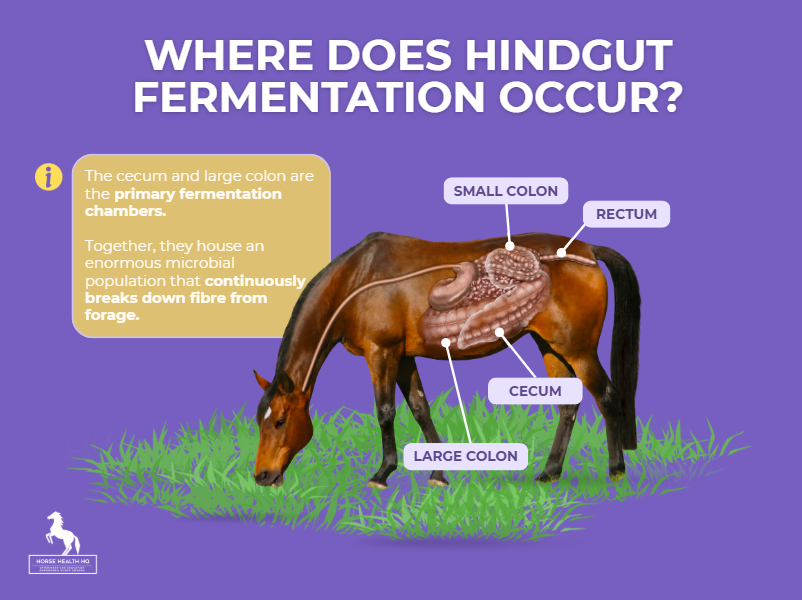
The hindgut consists of several structures:
- Cecum
- Large colon
- Small colon
- Rectum
The cecum and large colon are the primary fermentation chambers.
Together they house an enormous microbial population that continuously breaks down fibre from forage.
You can think of the hindgut as a living fermentation vat. As forage moves through the digestive tract, microbes go to work extracting energy from plant material that would otherwise pass through undigested.
This process continues as forage moves through the hindgut and microbes break down fibre, which is why long gaps without forage can affect how well this system functions.
How Fibre Becomes Energy
When a horse eats hay or pasture, digestion begins immediately.
The horse chews the forage, mixes it with saliva, and sends it through the stomach and small intestine.
Most fibre passes through these sections largely unchanged.
Once it reaches the hindgut, the microbes begin breaking it down through fermentation.
The resulting volatile fatty acids are absorbed into the bloodstream and used as fuel throughout the body (University of Maryland Extension).
This slow, steady release of energy is one reason forage-based diets are so important for horses. Owners often notice that horses on forage-based diets tend to have more consistent energy levels compared to those receiving large grain meals.
Unlike large grain meals that can create rapid changes in digestion, fibre provides a more consistent and natural energy source.
Why Fibre Is So Important
Fibre does much more than simply fill the stomach.
Adequate forage intake helps:
- Support healthy hindgut microbes
- Promote normal gut motility
- Encourage saliva production
- Help maintain digestive comfort
- Provide a steady source of energy
- Support normal manure consistency
- Reduce periods of an empty digestive tract
From a digestive standpoint, forage is not simply another feed ingredient.
It is the foundation of the equine diet.
Most horses should receive the majority of their daily intake from forage unless a veterinarian or qualified equine nutritionist recommends otherwise (there are some diseases and disorders that make this impossible). This is why many feeding plans start with evaluating hay or pasture before adjusting concentrates.
How Long Is Too Long Without Forage?
This is a common and very practical question.
Horses are designed to eat small amounts of forage almost continuously. In natural grazing conditions, they may spend 16 to 18 hours per day eating.
There is no single exact cutoff where the hindgut “shuts down,” but research and clinical experience suggest that extended periods without forage can begin to affect digestive function and behaviour.
As a general guideline:
- Many veterinarians aim to avoid gaps longer than 4 to 6 hours without forage
- Shorter gaps of 2 to 4 hours are often considered acceptable for many horses, especially if total daily forage intake is adequate
- Longer periods, particularly overnight gaps exceeding 6 hours, may increase the risk of digestive disturbances, gastric irritation, or behavioural issues such as wood chewing or cribbing (Merck Veterinary Manual; Ohio State University Extension)
So, is a 4-hour gap between turnout and evening hay okay?
- For many horses, a 4-hour gap is unlikely to cause problems, especially if they have had good forage intake earlier in the day
- However, horses that are prone to digestive issues, ulcers, or weight loss may benefit from more continuous access to forage
This is where management tools such as slow feeders, hay nets and grazing muzzles can make a real difference. By extending the time your horse spends eating, these tools help reduce long fasting periods while more closely mimicking the horse’s natural grazing behaviour.
If you’re unsure which slow-feeding option is best for your horse, or how to introduce one safely, read our complete guide to slow feeders, hay nets and grazing muzzles.
The goal is not perfection, but to minimise long stretches where the digestive tract is empty and fermentation slows down.
How Do I Safely Transition Between Different Types of Hay?
This is a situation many horse owners run into, especially when starting a new batch of hay or switching between types such as grass hay and alfalfa.
Even though hay is all considered forage, different hays can vary significantly in fibre content, protein levels, and how quickly they ferment in the hindgut. Because of this, a sudden switch can still disrupt the microbial population.
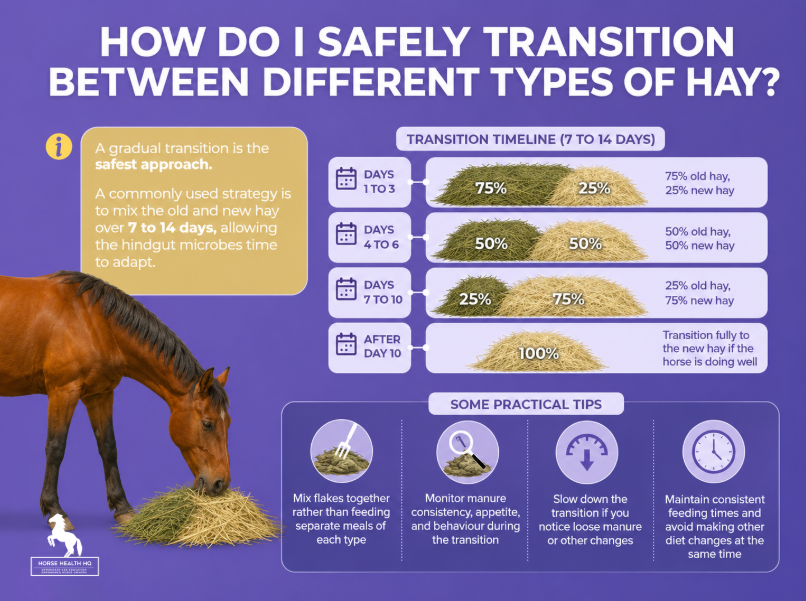
A gradual transition is the safest approach.
A commonly used strategy is to mix the old and new hay over 7 to 14 days, allowing the hindgut microbes time to adapt:
- Days 1 to 3: about 75% old hay, 25% new hay
- Days 4 to 6: about 50% old hay, 50% new hay
- Days 7 to 10: about 25% old hay, 75% new hay
- After day 10: transition fully to the new hay if the horse is doing well
If you are switching to a richer forage, such as introducing alfalfa or a higher-quality hay, it may be helpful to extend the transition period slightly.
Some practical tips:
- Mix flakes together rather than feeding separate meals of each type
- Monitor manure consistency, appetite, and behaviour during the transition
- Slow down the transition if you notice loose manure or other changes
- Maintain consistent feeding times and avoid making other diet changes at the same time
This gradual approach helps reduce the risk of upsetting the hindgut environment and supports a smoother adjustment to the new forage.
What Happens When Too Much Starch Reaches the Hindgut?
The horse’s small intestine is designed to digest limited amounts of starch from feeds such as grain.
When large amounts of starch are fed at one time, some may escape digestion in the small intestine and pass into the hindgut.
This can alter the microbial population and change the environment within the hindgut.
As starch-fermenting microbes increase, acidity may rise and fibre-digesting microbes can be negatively affected (Merck Veterinary Manual; Ohio State University Extension).
These changes have been associated with digestive disturbances and may contribute to conditions such as:
- Colic
- Diarrhoea
- Laminitis
- Reduced feed efficiency
In everyday terms, this is why feeding large grain meals can sometimes be followed by loose manure, signs of discomfort, or changes in behaviour.
This is one reason veterinarians and equine nutritionists often recommend avoiding large grain meals and making feed changes gradually.
What Counts as a “Large Grain Meal”?
This is one of the most common questions horse owners have, and it is an important one.
A “large grain meal” is not just about the weight of the feed. It depends on how much starch is being fed at one time and the size of the horse.
Evaluating this ‘large grain meal’ can involve some mathematical calculations and estimation, so we’ve provided some general examples below to make this easier for a busy horse owner to assess.
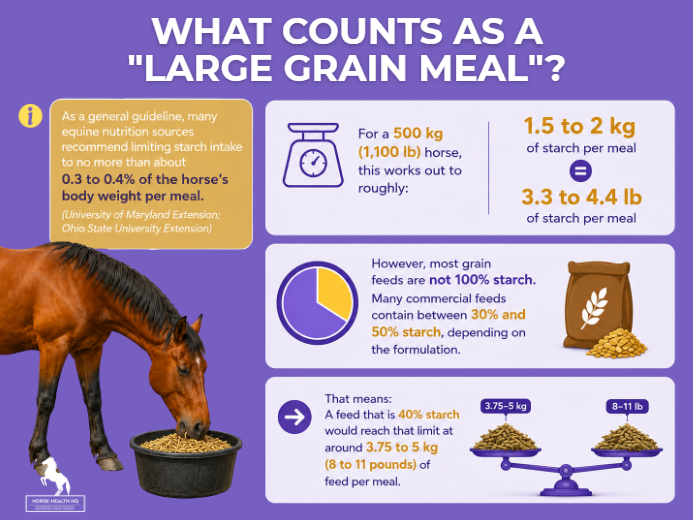
As a general guideline, many equine nutrition sources recommend limiting starch intake to no more than about 0.3 to 0.4% of the horse’s body weight per meal (University of Maryland Extension; Ohio State University Extension).
For a 500 kg (1,100 lb) horse, this works out to roughly:
- 1.5 to 2 kg of starch per meal (about 3.3 to 4.4 pounds of starch)
However, most grain feeds are not 100% starch. Many commercial feeds contain between 30% and 50% starch, depending on the formulation.
That means:
- A feed that is 40% starch would reach that limit at around 3.75 to 5 kg (8 to 11 pounds) of feed per meal
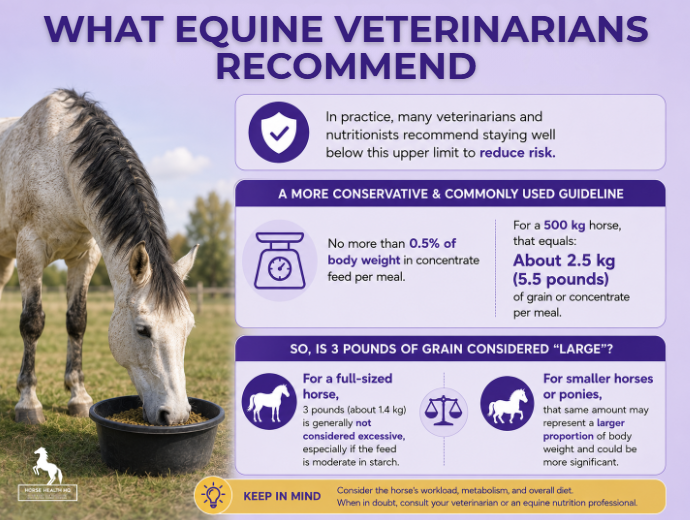
In practice, many veterinarians and nutritionists recommend staying well below this upper limit to reduce risk.
A more conservative and commonly used guideline is:
- No more than 0.5% of body weight in concentrate feed per meal
For a 500 kg horse, that equals:
- About 2.5 kg (5.5 pounds) of grain or concentrate per meal
So, is 3 pounds of grain considered “large”?
- For a full-sized horse, 3 pounds (about 1.4 kg) is generally not considered excessive, especially if the feed is moderate in starch.
- For smaller horses or ponies, that same amount may represent a larger proportion of body weight and could be more significant.
The key factors that determine whether a meal is “large” include:
- The horse’s body weight
- The starch percentage of the feed
- How many meals are fed per day
- The horse’s individual tolerance and health status
When in doubt, dividing grain into smaller, more frequent meals and prioritising forage is the safest approach.
What Can You Do If the Hindgut Is Already Disrupted?
This is where many horse owners feel stuck.
You may already be dealing with loose manure after a sudden feed change, a stressful trailer ride, or a change in routine, and you want to know what you can safely do right away.
While veterinary guidance is always important, there are some practical, low-risk steps that are commonly recommended to help support the hindgut while it stabilises.
Focus on Forage First
Providing consistent access to good-quality hay or pasture is one of the most important steps.
Forage helps support the normal microbial population and provides a steady source of fibre for fermentation. Avoid long gaps without forage during this time.
Reduce or Temporarily Limit Grain
If your horse is receiving grain or high-starch concentrates, it is often reasonable to reduce or temporarily remove these feeds for a short period, especially if loose manure developed after a dietary change.
This helps reduce the amount of starch reaching the hindgut and may allow the microbial population to stabilise.
If your horse has higher energy needs, speak with your veterinarian or nutritionist before making significant changes.
Keep Feed Changes Consistent
Avoid introducing new feeds or making additional changes while the hindgut is already unsettled.
Consistency gives the microbial population time to adapt and recover.
Ensure Adequate Water Intake
Encourage normal water consumption, as hydration plays an important role in maintaining normal manure consistency and digestive function.
Consider Digestive Support Products
Some owners choose to use products such as prebiotics, probiotics, or yeast-based supplements during periods of digestive upset.
- Prebiotics are intended to support beneficial microbes already present in the hindgut.
- Probiotics provide live microorganisms.
- Yeast products are commonly used in equine diets and may support fibre digestion.
Evidence for these products in horses is variable, and responses can differ between individuals. They may be helpful in some situations, but they are not a substitute for appropriate feeding management. These should be given on a case-by-case basis, and your veterinarian can advise on the best and most effective products as they will vary by region.
The American Association of Equine Practitioners (AAEP) also recommends management practices that support normal digestive function through appropriate feeding and forage intake.
Monitor Closely
Keep an eye on manure consistency, appetite, behaviour, and overall comfort.
If signs persist, worsen, or are accompanied by colic signs, fever, or reduced appetite, veterinary evaluation is important.
Factors That Can Disrupt Hindgut Health
Several management factors may influence hindgut function.
These include:
Sudden Feed Changes
Microbial populations require time to adapt to new feeds.
Abrupt dietary changes may increase the risk of digestive upset (University of Maryland Extension). This is why switching hay or introducing a new feed too quickly can sometimes lead to loose manure or mild colic signs.
Inadequate Forage Intake
Extended periods without forage or too little forage in general can affect normal digestive function and microbial activity. Horses that go long hours without hay may be more prone to digestive disturbances. Typically, horses should gradually consume 1.5-2% of their body weight in forage dry matter over a 24-hour period.
Stress
Travel, illness, changes in routine, and competition schedules may influence gut health. Owners often notice digestive changes during events, transport, or changes in environment.
Dehydration
Water plays an important role in maintaining normal digestive function. Reduced water intake can contribute to firmer manure or increased risk of impaction.
Dental Problems
Poor dentition can reduce chewing efficiency and make it more difficult for horses to process forage effectively. Routine equine dental examinations help ensure horses can chew forage properly throughout life. This can lead to longer fibres in manure or reduced feed utilisation.
Signs Your Horse May Have Digestive Problems
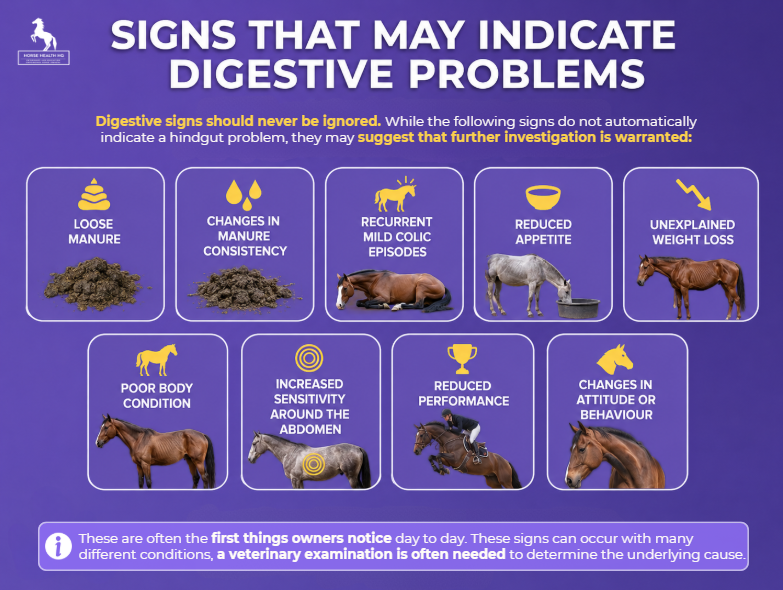
Digestive signs should never be ignored.
While the following signs do not automatically indicate a hindgut problem, they may suggest that further investigation is warranted:
- Loose manure (diarrhoea)
- Changes in manure consistency
- Recurrent mild colic episodes
- Reduced appetite
- Unexplained weight loss
- Poor body condition
- Increased sensitivity around the abdomen
- Reduced performance
- Changes in attitude or behaviour
These are often the first things owners notice day to day. Because these signs can occur with many different conditions, a veterinary examination is often needed to determine the underlying cause.
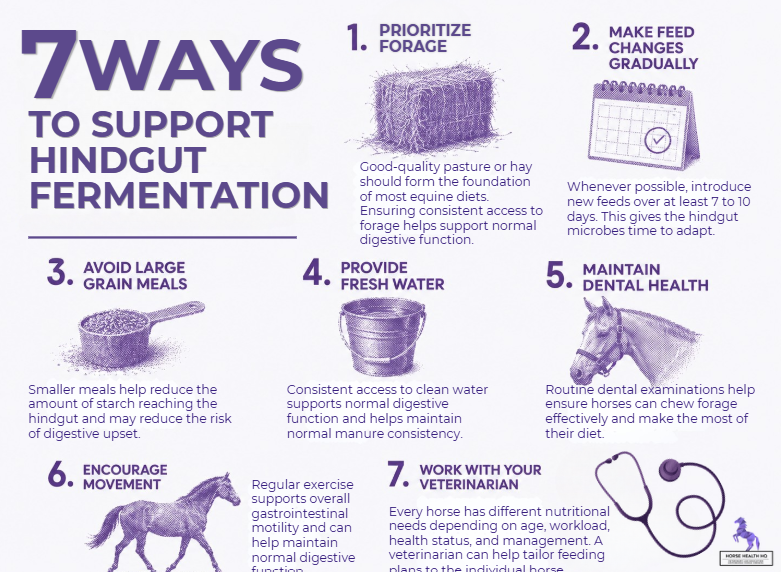
Seven Ways to Support Healthy Hindgut Fermentation
1. Prioritise Forage
Good-quality pasture or hay should form the foundation of most equine diets. Ensuring consistent access to forage helps support normal digestive function.
2. Make Feed Changes Gradually
Whenever possible, introduce new feeds over at least 7 to 10 days. This gives the hindgut microbes time to adapt.
3. Avoid Large Grain Meals
Smaller meals help reduce the amount of starch reaching the hindgut and may reduce the risk of digestive upset.
4. Provide Fresh Water
Consistent access to clean water supports normal digestive function and helps maintain normal manure consistency.
5. Maintain Dental Health
Routine dental examinations help ensure horses can chew forage effectively and make the most of their diet.
6. Encourage Movement
Regular exercise supports overall gastrointestinal motility and can help maintain normal digestive function.
7. Work With Your Veterinarian
Every horse has different nutritional needs depending on age, workload, health status, and management. A veterinarian can help tailor feeding plans to the individual horse.
Frequently Asked Questions About Hindgut Fermentation in Horses
What is a hindgut fermenter?
A hindgut fermenter is an animal that relies on microbial fermentation in the large intestine to digest fibre. Horses are hindgut fermenters because most fibre digestion occurs in the cecum and large colon.
Why are horses hindgut fermenters?
Horses evolved to consume forage for many hours each day. Their digestive system is designed to extract energy from fibre through microbial fermentation in the hindgut.
Where does hindgut fermentation occur in horses?
Most hindgut fermentation occurs in the cecum and large colon.
Can too much grain affect the hindgut?
Large grain meals may allow excess starch to reach the hindgut, potentially disrupting the normal microbial population and digestive environment.
What is the best feed for hindgut health?
For most horses, high-quality forage forms the foundation of a healthy diet. Specific nutritional recommendations should be tailored to the individual horse.
The Takeaway
The horse’s hindgut is home to a remarkable microbial ecosystem that helps transform fibre into usable energy.
This process, known as hindgut fermentation, is central to equine digestive health and one of the main reasons horses depend on regular access to forage.
For horse owners, this explains why feeding practices such as providing consistent forage, avoiding sudden diet changes, and limiting large grain meals are so often recommended.
By understanding how the hindgut works and supporting it through sensible feeding and management practices, horse owners can help promote digestive health, comfort, and overall wellbeing.
References
- Merck Veterinary Manual. Introduction to Digestive Disorders of Horses.
- Ohio State University Extension. The Gastrointestinal Tract of the Horse.
- University of Maryland Extension. Teaching Basic Equine Nutrition Part II: Equine Digestive Anatomy and Physiology.
- Merck Veterinary Manual. Feeding Practices in Horses and Other Equids.
- Iowa State University Extension. Digestive Anatomy and Physiology of the Horse.
Disclaimer
This article is intended for educational purposes only and does not replace professional veterinary advice. If your horse shows signs of digestive illness, colic, diarrhoea, weight loss, or other health concerns, contact your veterinarian promptly.