


Written by Dr Olivia James BVSc (Hons), MANZCVS (Equine Dentistry), CMAVA, DICEVO, DAVDC (Equine), an equine veterinarian and diplomat in equine dentistry.
Clinically reviewed by Dr. Apryle Horbal VMD, MPhil, MRCVS, DAVDC-EQ, a board-certified specialist in equine dentistry and oral surgery.
Most horse owners think of equine dentistry as “getting the teeth done” once a year.
And yes, removing sharp enamel points is an important part of routine dental care. But good equine dentistry is much more than simply floating teeth.
A proper dental examination is about understanding what is happening inside your horse’s mouth, finding problems early, and making sure your horse is comfortable enough to chew, carry a bit, maintain condition, and perform their job without unnecessary pain.
Horses are very good at hiding dental disease. Many will keep eating even when they have painful problems in the mouth.
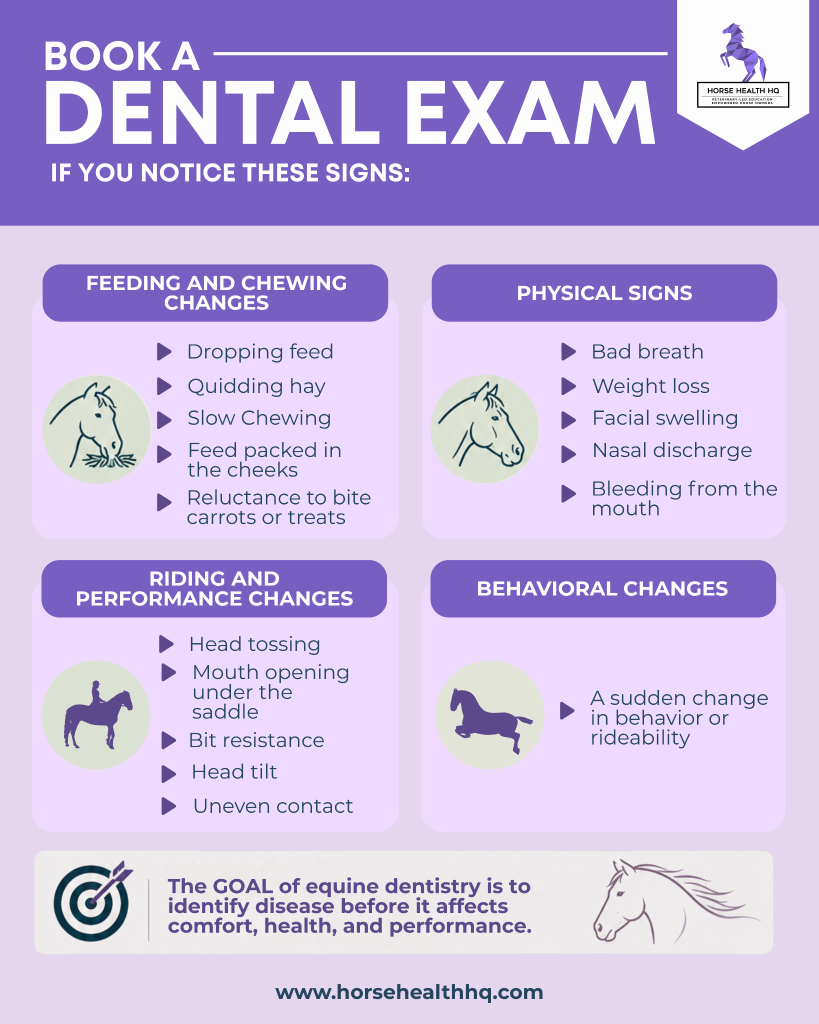
Some only show subtle changes: dropping feed, chewing on one side, resisting the bit, tilting the head, becoming harder to ride, or simply not feeling quite like themselves.
Those signs are easy to blame on age, behaviour, tack or training.
But often, the mouth has been trying to tell us something for a while.
As equine veterinarians, we are not just looking for sharp points. We are looking for fractured teeth, periodontal disease, feed packing, diastemata, painful incisors, infected tooth roots, sinus-related problems, and other conditions that can be missed without a complete examination.
That is why modern equine dentistry should start with diagnosis, not treatment.
Before we decide what needs to be floated, reduced, removed, treated, monitored, or referred, we need to examine the whole mouth properly. That usually means sedation, a full-mouth speculum, good lighting, dental mirrors or an oroscope, and careful charting of what we find.
This guide has been written for horse owners who want to understand what good equine veterinary dentistry should look like. You do not need to know every technical term or identify every tooth.
But you should feel confident asking good questions, recognising possible signs of dental pain, and understanding why your veterinarian may recommend more than a simple float.
Because equine dentistry is not just about teeth.
It is about comfort, welfare, performance, and helping your horse stay healthier for longer through proactive equine dentistry.
Table of Contents
- Why Dental Health Matters
- How Dental Problems Can Affect Performance
- Performance Signs That May Be Dental
- Basic Equine Dental Anatomy Owners Should Understand
- What Happens During a Proper Equine Dental Examination?
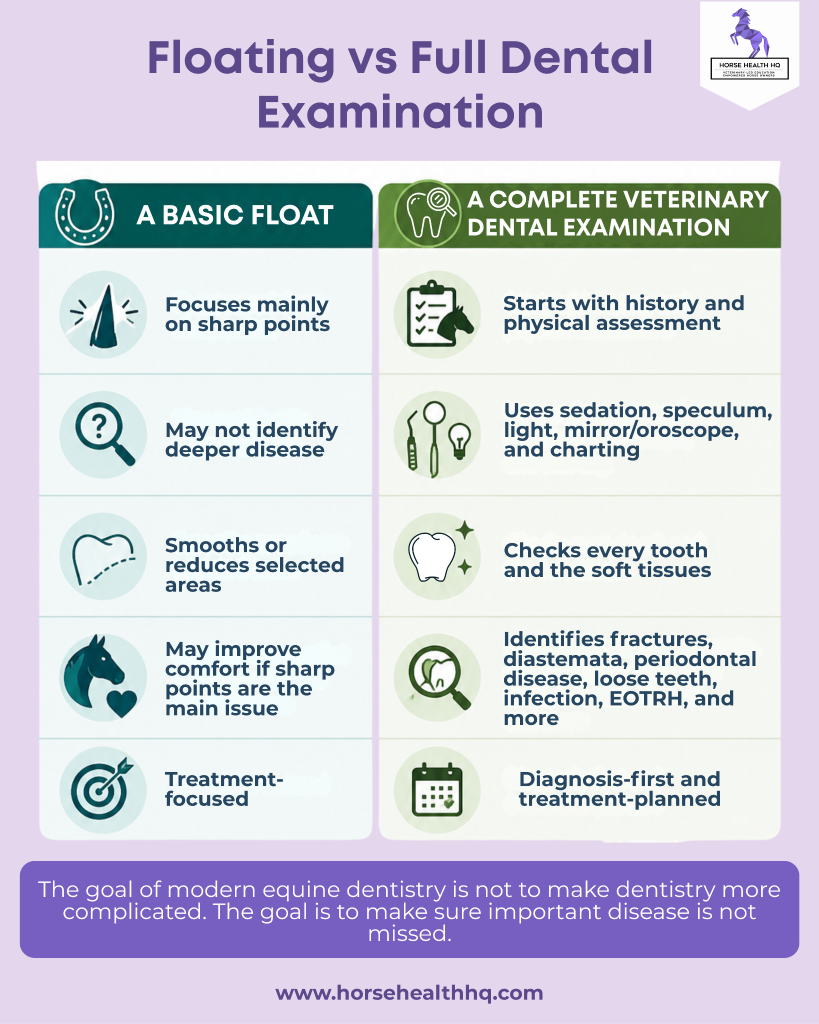
- Floating vs Full Dental Examination
- Sedation in Equine Dentistry
- Are Power Tools Safe in Horse Dentistry?
- Dental Equilibration and Occlusal Balance
- Common Conditions Found in Equine Dentistry
- Advanced Equine Dental Problems Owners Should Know About
- When Are Dental Radiographs Needed?
- When to Call Your Vet About Your Horse’s Teeth
- How Often Should Horses Have Dental Exams?
- Choosing the Right Equine Dental Provider
- What to Expect Before, During, and After an Appointment
- Frequently Asked Questions About Equine Dentistry
- Book a Complete Equine Dental Assessment
Why Dental Health Matters
Your horse’s mouth works hard every single day.
Every mouthful of hay, grass, or grain has to be chewed properly before it can be swallowed and digested. When the teeth are comfortable and working well, your horse can grind feed efficiently, maintain weight more easily, and get the best value from the food you are providing.
But when something is wrong in the mouth, the effects can show up in many different ways.
Some horses drop feed. Some pack hay or grass between their teeth and cheeks. Some chew slowly, lose weight, develop bad breath, or leave partially chewed balls of hay behind.
Others continue eating normally but become uncomfortable in the bridle, resistant to the bit, uneven in the contact, or less willing to work.
That is one of the difficult things about dental disease in horses. It does not always look obvious.
A horse can have significant dental pain and still walk up to the feed bin. They may still graze. They may still finish their dinner. This is why it can be easy to think, “He is eating, so his teeth must be fine.”
Unfortunately, it is not always that simple.
Dental problems can affect much more than chewing. Sharp enamel points can ulcerate the cheeks or tongue. Periodontal disease can cause painful pockets around the teeth. And since horses are prey animals, they are very good at hiding pain in their mouth until the disease is quite severe.
Gaps between teeth can trap feed and lead to infection. Fractured or infected teeth can cause facial swelling, sinus problems, nasal discharge, or long-term discomfort.
Good dental care and regular equine dentistry are not just about fixing problems once they are obvious. It is about finding issues early, before they become painful, expensive, or difficult to treat.
That is why regular, thorough dental examinations are such an important part of horse health and equine dentistry.
They help protect comfort, chewing, welfare, and performance – and they give us the chance to act before a small problem becomes a serious one.
How Dental Problems Can Affect Performance
One of the biggest misconceptions I hear from horse owners is this:
“If my horse had a sore mouth, surely he would stop eating.”
I understand why people think that. In ourselves, dental pain usually makes eating difficult very quickly. But horses are different. Many horses with significant dental disease will still eat.
Where dental discomfort often shows up first is not in the feed bin.
It shows up under saddle.
A horse with mouth pain may become fussy in the contact, heavier in one rein, resistant to bend, inconsistent in the frame, or reluctant to accept the bit. Some horses open the mouth, cross the jaw, toss the head, tilt the head, lean, rush, or become generally less rideable.
Of course, not every performance problem is dental. Saddle fit, lameness, training, rider balance, gastric ulcers, and many other factors can all play a role. But the mouth should always be part of the picture, especially when the change is new, unexplained, or worsening.
This is particularly important for horses in regular work. Even a small cheek ulcer, a sharp point near the bit, a blind wolf tooth, a fractured tooth, or feed packed between the teeth can change how a horse feels in the bridle.
Good equine dentistry is not about promising that every training issue will disappear after a dental. That would be far too simplistic.
Professional equine dentistry is about making sure the horse is not being asked to work through avoidable pain.
If a horse is uncomfortable in the mouth, they cannot be expected to carry the bit happily, relax through the jaw, or perform at their best.
Comfort comes first. Performance follows.
Performance Signs That May Be Dental
Use this as a quick checklist between equine dentistry visits:

Basic Equine Dental Anatomy Owners Should Understand
You do not need to know every tooth in your horse’s mouth. That is our job as veterinarians.
But it does help to understand the basics, because horse teeth are very different from human teeth.
Horses have incisors at the front of the mouth, which they use to bite and pull grass. Further back, they have large cheek teeth – the premolars and molars – which grind feed in a side to side motion. Some horses also have canine teeth, and some have small wolf teeth, which sit just in front of the first cheek teeth.
Unlike our teeth, horse teeth have a very long reserve crown below the gumline. Over time, the tooth slowly erupts into the mouth as the surface wears down from chewing.
This is why young horses have much longer teeth hidden within the jaw, and older horses may eventually start to run out of useful teeth.
Because the upper and lower jaws are not the same width, and because horses chew with a side-to-side grinding motion, sharp enamel points can develop along the edges of the cheek teeth. These points may rub against the cheeks or tongue and cause ulcers or discomfort.

Your veterinarian may also refer to teeth using numbers rather than names. This is called the modified Triadan system. It sounds complicated, but it is really just a standard way of identifying exactly which tooth we are talking about.
For example, instead of saying “the second upper cheek tooth on the left,” we can use a number that trained veterinarians understand.
Good dental charting matters because it allows us to track changes over time. If we find a small abnormality this year, we can monitor whether it has stayed the same, improved, or progressed at the next examination.
That is one of the reasons proper equine dentistry is more than just looking in the mouth and rasping a few sharp edges. We are assessing the whole mouth, tooth by tooth, and building a record that helps protect your horse’s long-term comfort.
What Happens During a Proper Equine Dental Examination?
A good equine dentistry visit should start before we put any instruments in the horse’s mouth.
First, your veterinarian will usually ask about your horse’s age, diet, workload, behaviour, previous dental history, and any changes you have noticed. Things like dropping feed, resisting the bit, losing weight, bad breath, head tossing, or nasal discharge can all give us useful clues.
Then we examine the horse from the outside. We look at body condition, facial symmetry, swelling, nasal discharge, jaw movement, and any obvious signs of pain or abnormal wear.
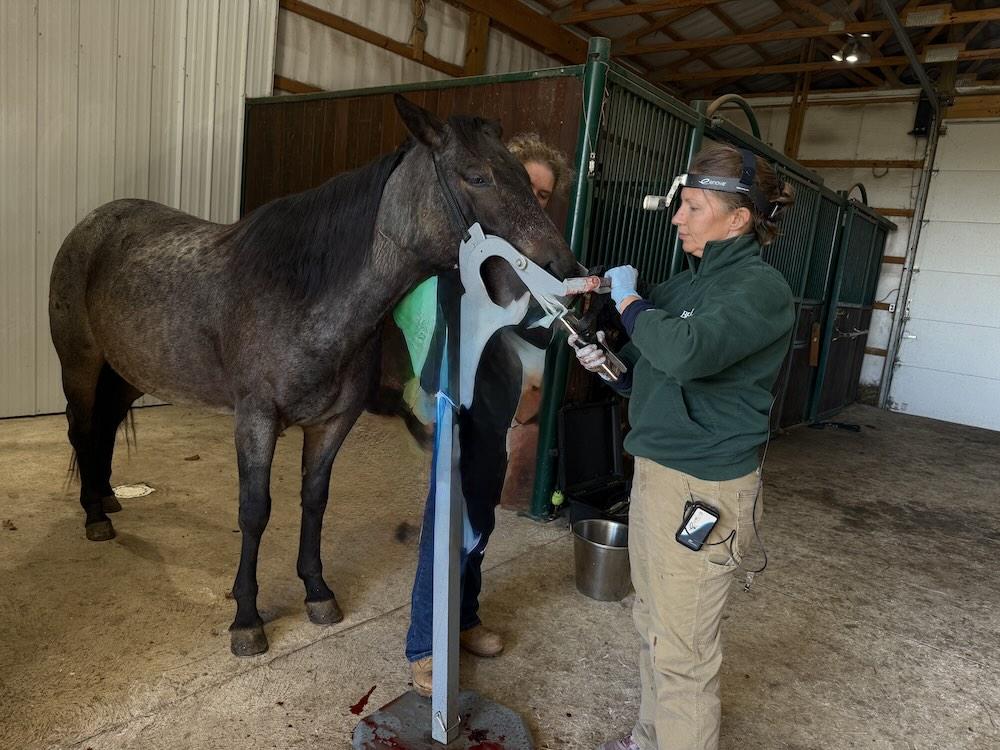
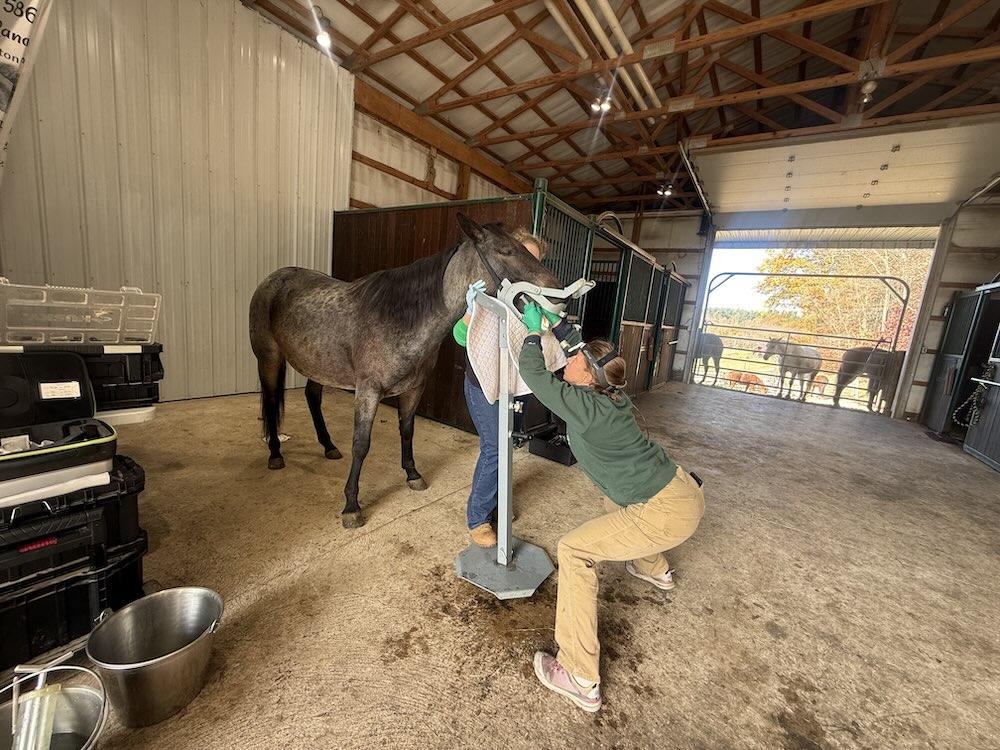
For a complete oral examination, nearly all horses need sedation. This allows the horse to stand calmly and lets us safely use a full-mouth speculum, which holds the mouth open so we can examine the teeth properly. With good light, a mirror or oroscope, and dental probes, we can assess much more than sharp points. Without the use of all of these tools, small issues will be missed – which can turn into much bigger issues in a very small amount of time!
We are looking for ulcers, fractures, gaps between teeth, feed packing, loose teeth, abnormal wear, painful periodontal pockets, infected teeth, and changes that may need radiographs or further treatment.
In this context, gaps between teeth are often called diastemata. These gaps can trap feed, irritate the gum, and lead to painful periodontal disease if they are not identified and managed.
Your veterinarian may also look for signs of EOTRH, which stands for Equine Odontoclastic Tooth Resorption and Hypercementosis. This is a painful dental condition that most commonly affects the front teeth of older horses and may require dental radiographs to assess properly.
Everything should be recorded on a dental chart. This means your horse has a clear record of what was found, what was treated, and what needs to be monitored.This is the part of equine dentistry that matters most: the diagnosis.
Floating or reducing sharp points may be part of the treatment, but it should not be the starting point. The starting point should always be a careful examination of the whole mouth, so the treatment plan is based on what your horse actually needs.
Sedation in Equine Dentistry: What Owners Need to Know
Many owners feel nervous when they hear that their horse needs to be sedated for dentistry. That is completely understandable.
But sedation is one of the main reasons modern equine dentistry is safer, more thorough, and more comfortable for the horse. When sedation is used by a veterinarian, it is very safe and effective. Your veterinarian will have already performed a full physical examination on your horse to ensure that they are healthy enough to be sedated.
Your veterinarian will take that examination along with the horse’s age, temperament, and history into account when selecting the appropriate sedative protocol. Complications from short-acting sedatives are very rare, but your veterinarian is also equipped to deal with any issues that may arise from sedating your horse.
Sedation is not to be taken lightly, however. No one aside from a veterinarian should sedate a horse as they are not able to appropriately evaluate the horse’s health prior to sedation, or deal with any complications that occur during a procedure.
Sedatives in the wrong hands can be very dangerous to horses with metabolic issues or heart murmurs, which is why they should only be used by qualified veterinary professionals.
A horse’s mouth is a large, dark, sensitive space. The back teeth are difficult to see properly, and many important problems sit well beyond what we can check with a quick look.
Without sedation, most horses will move their head, chew, pull away, or become anxious. That makes it very easy to miss disease.
Sedation allows us to examine the whole mouth properly. It lets us place a speculum safely, use a bright light, check each tooth, probe between teeth, and identify areas of pain or infection. It also helps protect the horse, the handler, and the veterinarian.
It is important to understand that sedation and pain relief are not the same thing.
Sedation helps the horse stand calmly. Pain relief addresses discomfort. For routine dental work and equine dentistry procedures, sedation may be enough alongside careful techniques.
For painful conditions, extractions, diastema treatment, or more advanced procedures, your veterinarian may also recommend local anaesthetic blocks, anti-inflammatory medication, or other pain relief.
The exact sedation plan depends on the individual horse. Age, temperament, health, workload, and the type of procedure all matter.
After sedation, your horse will need time to wake up fully before eating or travelling. Your veterinarian will tell you when it is safe to offer feed again and what to watch for during recovery.
Used properly, sedation is not something to fear. It is a tool that allows equine dentistry to be performed carefully, safely, and with far less stress for the horse.

Are Power Tools Safe in Horse Dentistry?
A lot of owners worry when they see or hear power tools being used in a horse’s mouth.
I understand that. The sound can be confronting, and it is natural to wonder whether it could damage the teeth.
The important thing to know is that power tools are not automatically good or bad. Like any instrument, they are only as safe as the person using them.
In experienced hands, power instruments can be very useful in equine dentistry. They allow precise, controlled reduction of sharp points and overgrowths, especially in areas of the mouth that are difficult to reach with hand tools alone.
The risk comes when too much tooth is removed, when the tool is held in one place for too long, or when there is not enough cooling. Horse teeth contain living tissue, and excessive heat or over-reduction can cause pain and damage.
In addition, power tools should ONLY be used in a sedated horse as unexpected movements or reactions to the noise of these instruments in an unsedated horse are incredibly risky.
That is why modern equine dentistry is not about “grinding teeth down.” It is about removing only what needs to be removed, preserving as many healthy teeth as possible, and constantly checking the mouth as we work.
A good equine practitioner will use light, controlled movements, appropriate equipment, water cooling where needed, and a clear understanding of the horse’s dental anatomy.
The tool itself is not the most important factor.
The diagnosis, the plan, and the skill of the person holding the tool matter far more in equine dentistry.
Dental Equilibration and Occlusal Balance
You may hear terms like “dental equilibration,” “occlusal balance,” or “balancing the mouth.”
In simple terms, this means correcting parts of the mouth that are interfering with normal chewing or jaw movement. That might include sharp points, hooks, ramps, waves, or other overgrowths.
Within equine dentistry, balance does not mean making every tooth perfectly flat or smooth. Horses need a natural grinding surface with some rougher or raised areas to chew properly. The aim is to preserve healthy teeth while correcting abnormalities that are causing pain, restriction, or uneven wear.
Good dental equilibration is a key part of equine dentistry. It should support comfort and function, not aggressively remove teeth.
Common Conditions Found in Equine Dentistry
During an equine dentistry examination, we are not just looking for sharp edges. We are looking for anything that may affect comfort, chewing, health, or performance.
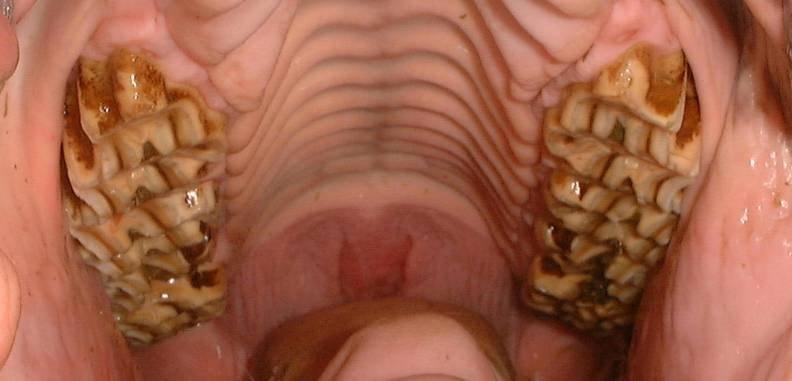
Sharp enamel points are one of the most common findings. These develop because of the way horses chew and because the upper and lower jaws do not line up perfectly. Sharp points can rub against the cheeks or tongue and may cause ulcers, pain, or resistance in the bridle.
Hooks, ramps, waves, and steps occur when parts of the teeth do not wear evenly. Mild changes may need monitoring or careful correction. More significant changes can affect jaw movement and chewing comfort.
Periodontal disease affects the structures that support the teeth, including the gum and surrounding tissues. It can be painful and is often linked with feed packing, infection, bad breath, and loose teeth.
Diastemata are gaps between teeth where feed can become trapped. This packed feed can rot, irritate the gum, and create painful pockets. Horses with diastemata may quid hay – meaning they drop partially chewed balls of hay or feed from their mouth – smell unpleasant from the mouth, or resent pressure from the bit.
Fractured teeth are more common than many owners realise as horses do not often show obvious signs of pain even with a severe fracture. Some fractures are minor and can be monitored. Others expose sensitive structures inside the tooth or allow infection to develop. These cases may require radiographs, treatment, or extraction.
Tooth root infections can sometimes show up as facial swelling, a draining tract, nasal discharge, or sinus problems. In other cases, the signs are subtle and only become obvious during a thorough oral examination or imaging.
Wolf teeth may be relevant, especially in ridden horses. Most wolf teeth do not cause a problem, but occasionally can interfere with the bit or become painful if they are blind (retained under the gingiva), displaced, or positioned awkwardly.
Older horses need particular care because their teeth change with age. They may develop loose teeth, worn-out teeth, gaps, infections, or chewing difficulties that gradually affect condition.
The important point is this: many dental conditions cannot be properly assessed from the outside. A horse may look normal, eat reasonably well, and still have painful disease in the mouth. This is why regular equine dentistry examinations are so valuable.
Advanced Equine Dental Problems Owners Should Know About
Some dental problems are more complex than routine sharp points or mild overgrowths. You do not need to diagnose these yourself, but it is helpful to know they exist.
Infundibular caries are areas of decay that can occur in the upper cheek teeth. These teeth have natural enamel folds in the centre of the tooth. In some horses, those areas do not fill normally or become diseased over time.
Your equine oral health vet may describe infundibular caries by grade or severity. Mild cases may be monitored, especially if the tooth is still strong and there is no sign of infection.
More advanced cases may weaken the tooth, increase the risk of fracture, or allow infection to develop deeper inside. Depending on the grade, position, and radiographic findings, treatment may involve monitoring, cleaning and restoration, or in severe cases, extraction.
EOTRH stands for equine odontoclastic tooth resorption and hypercementosis. It most commonly affects the incisor teeth of older horses, and is actually an immune-mediated process in which the horse’s own body begins to attack and resorb the incisors and canines, eventually causing the teeth to degrade and become loose and often infected.
Owners may notice the horse becoming reluctant to bite carrots, sensitive around the lips, uncomfortable with the bit, or unhappy when the front teeth are touched. Sometimes the gums look inflamed, the teeth appear bulbous, or small draining tracts develop.
Endodontic disease means the inside of the tooth is involved. This may happen after a fracture, infection, or damage to the pulp. These cases often need radiographs to understand what is happening below the gumline.
Complex extractions may be needed when a tooth is fractured, infected, loose, or causing ongoing pain. Some teeth can be removed standing under sedation with appropriate pain relief. Others require referral or a more advanced surgical approach.
The reason these conditions matter is simple: they are not always obvious from the outside. A horse can have a serious dental problem without dramatic signs. That is why a careful examination, good records, and radiographs when needed are so important.
When Are Dental Radiographs Needed in Equine Dentistry?
Radiographs are not needed for every routine equine dentistry visit, but they are very useful when we need to see what is happening below the gumline.
Your veterinarian may recommend dental radiographs if your horse has facial swelling, nasal discharge, a draining tract, a fractured tooth, loose teeth, missing teeth, suspected tooth root infection, sinus problems, or painful incisors.
For example, right-sided nasal discharge may indicate that there is a problem with one (or several) cheek teeth in the horse’s right maxilla. But without radiographs, your vet won’t know which tooth needs to be extracted as the problem is often contained at the root of the tooth.
Radiographs are also important when assessing conditions such as EOTRH, advanced periodontal disease, and some cases of infundibular caries. They help us understand whether a tooth is healthy, infected, fractured, displaced, or losing support.
This matters because the part of the tooth we can see in the mouth is only part of the story. A tooth may look reasonably normal on the surface but have significant disease deeper in the jaw.
Radiographs help guide the treatment plan. They can tell us whether a tooth should be monitored, treated, extracted, or referred for more advanced care.
If your veterinarian recommends radiographs, it is not because they are trying to make the appointment more complicated. It is because they need more information to make the safest decision for your horse.
How Often Should Horses Have Equine Dentistry Exams?
Most horses should have an equine dentistry examination at least once a year.
That does not mean every horse will need the same amount of treatment every year. Some horses may only need a small amount of routine maintenance. Others may need more detailed work, radiographs, follow-up appointments, or a shorter interval between visits.
Young horses often need more regular checks while their mouth is changing. They are losing baby teeth, erupting adult teeth, and sometimes developing sharp points, caps, wolf teeth, or early bite problems.
Performance horses also benefit from regular dental care because small areas of discomfort can affect contact, softness, head carriage, and rideability.
Older horses may need closer monitoring because teeth become worn, loose, displaced, or less effective with age. A senior horse that starts dropping feed, losing weight, quidding hay, or taking longer to eat should be checked promptly.
Horses with known dental disease may need rechecks every few months, depending on the condition. Periodontal disease, diastemata, EOTRH, fractured teeth, and complex malocclusions often need ongoing management rather than a once-a-year quick visit.
The best schedule is the one your horse dentist recommends after examining your horse. Age, workload, diet, dental history, and current findings all matter.
Choosing the Right Equine Dentistry Provider
Choosing who provides your horse’s equine dentistry care is an important decision.
The first question should not be , “Can this person float teeth?”
The better question is, “Can this person properly examine, diagnose, treat, and advise me on what my horse actually needs?”
A good dental provider should be able to explain what they are doing and why. They should examine the whole mouth, not just remove sharp points.
They should be comfortable discussing sedation, pain relief, charting, radiographs, and referral if the case needs more advanced care.
This is one of the reasons veterinary-led dentistry is so important. Dental disease is a medical disease. Horses may need sedation, analgesia, radiographs, anti-inflammatories, nerve blocks, extractions, or management of other health conditions at the same time.
That does not mean every dental visit needs to be complicated. Many horses simply need a routine examination and careful maintenance.
But when something more serious is found, you want a provider who can recognise it and guide you through the next step.
A good appointment should leave you with a clear understanding of what was found, what was treated, and what needs to be monitored. You should never feel silly asking questions. Your horse’s dental care is a partnership, and you deserve to understand the plan.
What to Expect Before, During, and After an Appointment
Before your horse’s equine dentistry appointment, choose a safe, quiet area with good footing and enough space for your equine dentistry veterinarian to work. If possible, avoid feeding a large meal immediately beforehand, as the mouth will need to be rinsed and examined. A shaded area indoors is often preferable, and access to running water (particularly warm water) are pluses!
Your veterinarian will usually start with a history and physical examination, then sedate your horse if a full examination is being performed. Once your horse is relaxed, a speculum is placed so the mouth can be opened safely. The mouth is rinsed, examined, charted, and then any required treatment is carried out.
After the appointment, your horse will need time to recover from sedation. Most horses are sleepy for a while and should not eat until they are awake enough to chew safely. Your veterinarian will tell you when to offer feed and whether any aftercare, medication, or follow-up is needed.
Some horses return to normal very quickly. Others, especially those that have had extractions or treatment for painful disease, may need a softer diet or a recheck. However – your horse should NEVER have difficulty chewing hay or their usual grain/hard feed after what would be considered a ‘routine’ treatment where only sharp enamel points and small overgrowths were removed. If this has occurred in the past, that could mean that your horse was over-floated by a practitioner, and a second opinion may be warranted.
Before your equine dental vet leaves, you should know three things:
- What was found.
- What was done.
- When your horse should be seen again.

Frequently Asked Questions About Equine Dentistry
What is equine dentistry?
Equine dentistry is the examination, diagnosis, treatment, and prevention of problems affecting a horse’s mouth and teeth. It includes routine care, such as reducing sharp enamel points, but it also includes identifying dental disease, pain, infection, fractures, and age-related changes.
Is floating the same as dentistry?
Not quite. Floating usually refers to smoothing or reducing sharp points and overgrowths. Dentistry is broader than that. A proper dental visit should include examination, diagnosis, charting, treatment planning, and then any floating or other treatment that is needed.
How often should my horse have an equine dentistry exam?
Most horses should have an equine dentistry examination at least once a year. Young horses, older horses, performance horses, and horses with known dental disease may need more frequent checks.
Does my horse need sedation for dentistry?
For a complete oral examination, sedation is usually needed. It helps the horse stand calmly and allows the veterinarian to safely examine the whole mouth. Without sedation, it is very easy to miss important problems at the back of the mouth.
Are power tools safe?
Yes, when they are used correctly and when the horse is properly sedated. The key is conservative technique, proper cooling, and a clear treatment plan. The aim should never be to grind teeth aggressively, but to carefully remove only what is necessary.
Can dental problems affect performance?
Yes. Dental pain may contribute to bit resistance, head tossing, mouth opening, head tilt, difficulty bending, or reluctance to accept the contact. Dental problems are not the only possible cause of these signs, but they should always be considered.
What signs suggest my horse has dental pain?
Common signs include dropping feed, quidding hay – dropping partially chewed balls of hay or feed from the mouth – bad breath, weight loss, slow chewing, feed packing, facial swelling, nasal discharge, bit resistance, head tossing, or changes in behaviour. Some horses show very few signs, even with significant disease.
What is EOTRH?
EOTRH is a painful disease that most commonly affects the incisor teeth of older horses. Horses may become reluctant to bite, sensitive around the lips, uncomfortable in the bridle, or show changes around the gums and roots of the front teeth.
When are radiographs needed?
Radiographs may be recommended if your equine dental practitioner suspects disease below the gumline, such as tooth root infection, fracture, EOTRH, sinus involvement, or advanced periodontal disease. They help guide safer treatment decisions.
What are diastemata?
Diastemata are gaps between teeth. Feed can become trapped in these gaps, leading to gum inflammation, infection, bad breath, and pain. They are an important cause of periodontal disease in horses.
Book a Complete Equine Dentistry Assessment
If your horse is due for a dental examination, or you have noticed changes in eating, behaviour, bit acceptance, head carriage, or performance, the next step is not to guess whether your horse “just needs a float.”
The next step is a complete veterinary equine dentistry assessment.
A thorough examination allows your veterinarian to understand what is happening in the mouth, explain the findings clearly, and create a treatment plan that is appropriate for your horse.
Sometimes that plan is simple routine maintenance. Sometimes it involves radiographs, follow-up care, or referral for more advanced treatment.
Either way, the goal is the same: a healthier, more comfortable horse.
Book your horse’s complete dental assessment today and give them the comfort, care, and attention their mouth deserves.
If you are unsure where to find a trusted equine dentistry veterinarian in your area, we can help point you in the right direction.
Through our sister company, The Equine Practice Company, we work with equine veterinarians around the world who are committed to continuing education and modern, evidence-based dental care.
Simply join our private community, tell us where you are located, and share a little about what is happening with your horse.
We will do our best to connect you with, or point you toward, an equine veterinarian who understands current approaches to equine dentistry and can help your horse receive the thorough, thoughtful care they deserve.